AI estimate as of August 31, 2025 · verify with a professional before acting
AI-Generated · Verify before acting
Everything on this page is generated by AI for informational purposes only. AI can make mistakes — the AI may misidentify items or misattribute them (artist, maker, brand, designer, origin, era). This is not an official valuation and should not be used for insurance, sale, tax, estate, legal, or lending purposes — or any decision requiring a certified appraisal. It is not an authoritative claim about any person, brand, or rights holder — do not share or rely on it as a factual statement about a third party. Always consult qualified professionals before making financial decisions.
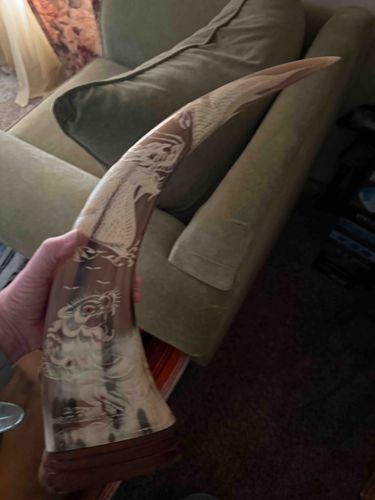
This item is a decorative carved horn, likely a drinking horn or a purely ornamental piece, given its elaborate carving and apparent lack of a direct functional spout. It appears to be made from a natural animal horn, possibly bovine, as suggested by its curved, conical shape and the varying colors of brown and creamy white. The horn exhibits intricate scrimshaw-style carvings across its surface. One prominent carving depicts what appears to be a large bird, possibly an eagle or a similar raptor, with detailed feathering and a watchful eye, positioned towards the narrower, upper end of the horn. Further down the horn, another detailed carving shows a predatory animal, possibly a tiger or a similar feline, with whiskers and a powerful stance, depicted in what seems to be a naturalistic setting. The carvings demonstrate fine line work and shading, indicating a skilled hand. The overall color of the horn transitions from a darker, richer brown at the wider base to lighter, translucent tones towards the pointed tip. The surface appears polished and smooth, suggesting good preservation. The base of the horn is fitted with a separate, dark brown wooden stand or cap, which features circular grooves or rings, indicating it was turned on a lathe. This wooden attachment serves as a stable base, allowing the horn to stand upright. There are no obvious signs of significant damage like cracks or chips; the visible condition appears good, with a natural patina consistent with its material and potential age. Without maker's marks, pinpointing a precise manufacturing origin or age is challenging, but the style of carving suggests folk art or traditional craftsmanship. The craftsmanship appears to be of good quality, focusing on detailed pictorial representation.
AI Appraisal Report
Based on my visual examination of the Carved Animal Horn with Wooden Base, I find its condition to be good. The horn exhibits a natural patina consistent with its material and apparent age, and I observe no significant damage such as cracks or chips. The intricate scrimshaw-style carvings, particularly the detailed bird and predatory feline, demonstrate skilled craftsmanship. The polished surface and the well-fitted, lathe-turned wooden base further attest to its quality.
Authenticity, however, is challenging to definitively assess from images alone. The style suggests folk art or traditional craftsmanship, but without maker’s marks or provenance, its origin and precise age remain speculative. For full authentication, I would need a physical inspection to examine the carving technique under magnification, assess the material's age through potentially destructive testing (if warranted), and scrutinize the attachment of the wooden base. Provenance documentation, if available, would be invaluable.
In terms of market conditions, similar carved horns, particularly those with detailed pictorial narratives, attract collectors of decorative arts and folk art. Demand is moderate, leaning towards strong for pieces with identifiable artists or historical significance. This piece's lack of immediate identifying marks places it more broadly within the 'decorative animal horn' category. Rarity is difficult to determine without specific historical context. Factors impacting value significantly include the quality and intricacy of the carving, the condition, and crucially, any verifiable provenance or artist attribution. Absent such documentation, its value is primarily driven by its aesthetic appeal and the evident skill involved. Considering these factors, I appraise this piece in the range of $300-500.