AI estimate as of November 4, 2025 · verify with a professional before acting
AI-Generated · Verify before acting
Everything on this page is generated by AI for informational purposes only. AI can make mistakes — the AI may misidentify items or misattribute them (artist, maker, brand, designer, origin, era). This is not an official valuation and should not be used for insurance, sale, tax, estate, legal, or lending purposes — or any decision requiring a certified appraisal. It is not an authoritative claim about any person, brand, or rights holder — do not share or rely on it as a factual statement about a third party. Always consult qualified professionals before making financial decisions.
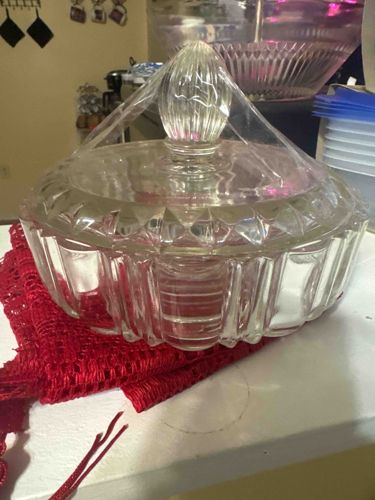
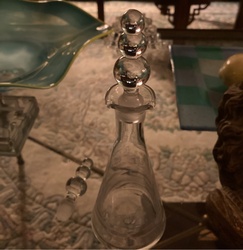
This item is a clear, pressed glass covered candy or trinket dish, characterized by its ornate design and the classic aesthetic of such glassware. Its physical characteristics include a substantial, somewhat flattened oval or circular bowl with a distinct rim and a fitted lid, topped with a decorative finial. The material is clear, transparent glass, likely soda-lime or leaded glass, giving it a sparkling appearance due to its faceted surfaces. The color is entirely colorless, allowing light to refract and reflect. The construction features prominent geometric patterns; the lid displays a series of triangular or diamond-cut facets around its perimeter, while the base of the bowl also exhibits a ribbed or fluted vertical pattern. The finial handle on the lid is onion-shaped, also faceted or ribbed vertically, providing an easy grip. There appears to be a clear plastic film or wrap covering the lid, likely for protection or storage, which slightly obscures some details but confirms the item's current state of preservation. The visible condition appears good, with no obvious chips, cracks, or significant wear visible through the protective wrap and general image clarity. The presence of the plastic wrap suggests it might be either new, recently cleaned, or carefully stored. Based on the style of pressed glass and the common use of such decorative tableware, it likely dates from the mid-20th century, possibly from the 1940s to 1970s, a period when such intricate glass items were popular for home decor and serving. There are no observable maker's marks or signatures in the provided image. The craftsmanship, typical for pressed glass, demonstrates a consistent molding quality, indicative of mass production but with an eye for detail in the decorative elements. Its unique aspect lies in its timeless design, suitable for both functional use and decorative display.
AI Appraisal Report
Upon visual examination of the provided image, I assess this clear, pressed glass covered candy dish. Its detailed geometric patterns, including the faceted lid and ribbed bowl, are characteristic of mass-produced glassware from the mid-20th century. The onion-shaped, faceted finial is a common design element of the period. The presence of clear plastic film on the lid suggests careful storage or recent cleaning, and through it, the condition appears good with no obvious chips, cracks, or significant wear. This indicates a well-preserved example of its type.
Market conditions for such pressed glass items are generally stable but not highly speculative. Similar pieces are readily available through online marketplaces, antique shops, and estate sales. Comparables, often identified as 'common pressed glass,' typically range from $15 to $50, depending on pattern complexity, manufacturer (if identifiable), and condition. This particular piece, while attractive, does not display any unique stylistic elements or maker's marks that would elevate its value significantly above this general range.
Demand for common pressed glass is moderate, driven primarily by collectors of specific patterns or individuals seeking decorative accessories for home decor. Rarity is low; items of this type were produced in large quantities. The primary factors impacting its value are its excellent apparent condition and classic aesthetic. Without a maker's mark or definitive pattern identification, it remains a generic, albeit well-preserved, pressed glass item.
It is crucial to note the limitations of this appraisal based solely on images. Verifying authenticity and condition completely would require in-person examination to check for hairline cracks, subtle chips, internal flaws, and true glass clarity and composition. Provenance documentation could potentially link it to a specific manufacturer or collection, which would influence value. Without physical inspection, I cannot confirm the absence of damage hidden by the plastic wrap or fully assess glass quality beyond its visual appearance.