AI estimate as of July 14, 2025 · verify with a professional before acting
AI-Generated · Verify before acting
Everything on this page is generated by AI for informational purposes only. AI can make mistakes — the AI may misidentify items or misattribute them (artist, maker, brand, designer, origin, era). This is not an official valuation and should not be used for insurance, sale, tax, estate, legal, or lending purposes — or any decision requiring a certified appraisal. It is not an authoritative claim about any person, brand, or rights holder — do not share or rely on it as a factual statement about a third party. Always consult qualified professionals before making financial decisions.
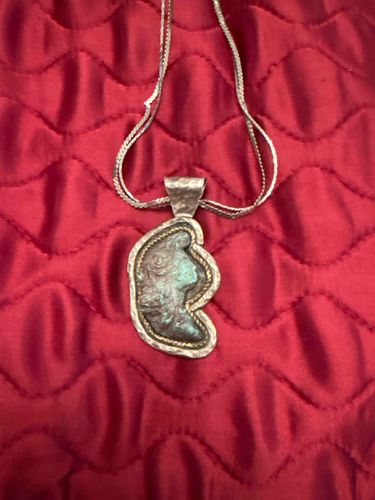
This is a pendant necklace featuring a central element with a profile of a classical figure, likely a Roman or Greek bust, possibly carved from a natural material such as shell or stone, but now exhibiting significant verdigris or patina, suggesting it may be a copper or bronze material that has oxidized over time. The profile is set into a silver-toned metal bezel that irregularly follows the contours of the bust. The bezel\'s outer edge appears hand-hammered or textured, giving it an artisanal, rustic feel. A delicate twisted wire accent is visible between the inner edge of the bezel and the central figure. A bail, also made of the same silver-toned, likely hammered metal, is affixed to the top of the pendant, allowing it to hang from a necklace. The necklace itself is a double-strand, snake-chain style, also in a silver-toned metal, possibly sterling silver given the overall appearance. The entire piece has an antique or vintage aesthetic, with visible wear and oxidation, particularly on the central figure, which contributes to its character. The craftsmanship appears to be handmade, indicating a unique piece rather than mass-produced. There are no discernible maker's marks or signatures visible in the image. The estimated age is likely mid-20th century or earlier, given the style and patina.
AI Appraisal Report
Upon examining the provided image of the Classical Bust Profile Pendant Necklace, I observe several key characteristics that inform my appraisal. The central element, depicting a classical profile, exhibits significant verdigris or patina, suggesting it is likely a copper or bronze alloy that has oxidized over time rather than natural shell or stone. This oxidation, while adding to its antique character, also masks potential details of the craftsmanship of the bust itself. The silver-toned metal bezel, with its irregular contours and hand-hammered texture, along with the twisted wire accent, indicates handmade craftsmanship. The double-strand snake chain is consistent with the overall vintage aesthetic.
Condition: The piece displays clear signs of age and wear, particularly the heavy oxidation on the central bust and some visible wear on the silver-toned components. This 'patina of age' contributes positively to its vintage appeal for many collectors, rather than detracting from it. Authenticity, based on visual examination alone, points towards a genuine vintage item, likely mid-20th century or earlier. The artisanal quality suggests it is not a mass-produced modern reproduction.
Market Conditions & Comparables: Similar vintage artisan pendants, particularly those with classical or historical motifs and exhibiting natural patina, fetch varied prices. Pieces made from non-precious metals with an emphasis on design and craftsmanship typically fall into a moderate price range. Comparables would include hand-wrought copper or bronze pendants from the Art Nouveau, Arts and Crafts, or Mid-Century periods.
Demand & Rarity: The demand for unique, handcrafted vintage jewelry remains steady, especially for items with character and a sense of history. While not exceedingly rare, the individuality of this piece due to its handmade nature makes it less common than mass-produced items.
Factors Impacting Value: The primary value drivers are the unique handmade craftsmanship, the appealing antique aesthetic, and the historical motif. The use of non-precious metals (copper/bronze for the bust, base metal for the silver-toned components, if not sterling) limits its intrinsic material value. The heavy patina, while desired by some, could be seen as a condition issue by others.
Limitations in Authenticity Verification: It is crucial to note that without physical examination, definitively determining the exact metal composition (especially of the 'silver-toned' components), the precise method of bust creation (e.g., cast vs. carved), or accurately dating the piece is difficult. An in-person examination would allow for closer inspection of surface details, weight, and potential hidden marks. Metallurgical testing would confirm metal composition. Provenance documentation, if available, would provide invaluable historical context and verify the age and origin.