AI estimate as of August 3, 2025 · verify with a professional before acting
AI-Generated · Verify before acting
Everything on this page is generated by AI for informational purposes only. AI can make mistakes — the AI may misidentify items or misattribute them (artist, maker, brand, designer, origin, era). This is not an official valuation and should not be used for insurance, sale, tax, estate, legal, or lending purposes — or any decision requiring a certified appraisal. It is not an authoritative claim about any person, brand, or rights holder — do not share or rely on it as a factual statement about a third party. Always consult qualified professionals before making financial decisions.
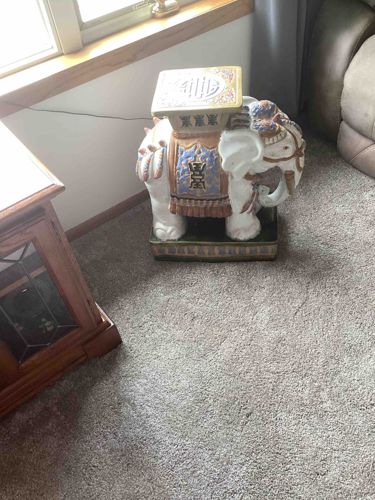
This item is a decorative ceramic elephant garden stool or plant stand, designed in a traditional Asian, likely Chinese, style. It is primarily white with multi-colored glaze accents in shades of blue, gold, green, and brown. The elephant is depicted in a standing pose, with its trunk curled upwards and its ears prominently displayed. Adorning its back is an ornate, saddle-like structure that forms the flat, square top surface of the stool. This 'saddle' features intricate patterns, including what appears to be a Chinese character or symbol on the top surface, possibly representing good fortune or longevity, surrounded by geometric and floral motifs in gold and white. The sides of the saddle are decorated with blue panels featuring a central golden symbol, possibly another character or a stylized motif, framed by brown and gold borders. Beneath the saddle, a decorative 'tapestry' or blanket is depicted in relief, with fringed edges and patterned details. The elephant's ears and tail have modeled details, and its tusks are depicted in a muted, off-white or light grey tone, blending with the body. The base upon which the elephant stands is a rectangular plinth with patterned sides, glazed in shades of green and brown. The overall construction appears to be molded ceramic with hand-applied glazes, indicating a level of craftsmanship that is typical of such garden stools. The visible condition suggests some age and possibly a light patina or dust, but no obvious chips, cracks, or significant damage are discernible from the image. The glaze appears consistent, suggesting original finish. Based on the style and craftsmanship, it likely dates from the mid-20th century to contemporary production, emulating traditional Asian ceramic designs. Its sturdy form is suitable for use as an indoor or outdoor decorative accent, small side table, or plant stand.
AI Appraisal Report
I have examined the provided image of this ceramic elephant garden stool/plant stand. Visually, the piece appears to be in good condition with no readily apparent chips, cracks, or significant damage. The glaze consistency suggests it retains its original finish. The design is a traditional Asian style, likely Chinese, characteristic of mid-20th century to contemporary production, emulating older designs. The intricate multi-colored glazes and molded details, particularly the 'saddle' and 'tapestry' elements, indicate a good level of craftsmanship typical of such pieces.
Establishing definitive authenticity and age from an image alone is challenging. While it appears to be a genuine decorative ceramic object of its type, without physical inspection, I cannot confirm materials, construction methods, or the presence of maker's marks that would verify origin or precise age. An in-person examination would allow for tactile assessment of the ceramic body, glaze quality, and detailed inspection for repair or restoration. Provenance documentation, if available, would significantly aid in authenticity. Scientific testing, like thermoluminescence dating, could provide a more precise age, but this is usually reserved for higher-value antiques.
In terms of market conditions, ceramic garden stools, especially those with animal forms like elephants, are consistently popular decorative accents. Their dual function as a stool or plant stand adds to their appeal. While not rare, well-executed examples with intricate glazes and appealing designs like this one command a steady demand. Comparables in the retail market, including online decorative arts platforms and antique shops specializing in Asian decor, range widely based on size, detail, and condition. Factors impacting value include the intricacy of the decoration, the vibrancy and integrity of the glazes, and the absence of damage. I do not see any specific characteristics that would suggest this particular piece is exceptionally rare or historically significant beyond its decorative appeal.