AI estimate as of November 10, 2025 · verify with a professional before acting
AI-Generated · Verify before acting
Everything on this page is generated by AI for informational purposes only. AI can make mistakes — the AI may misidentify items or misattribute them (artist, maker, brand, designer, origin, era). This is not an official valuation and should not be used for insurance, sale, tax, estate, legal, or lending purposes — or any decision requiring a certified appraisal. It is not an authoritative claim about any person, brand, or rights holder — do not share or rely on it as a factual statement about a third party. Always consult qualified professionals before making financial decisions.
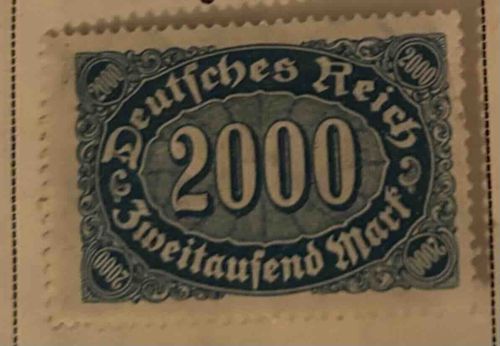
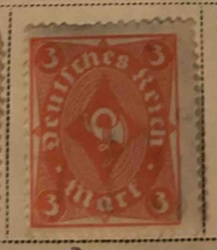
This item is a historical German postage stamp, specifically from the inflation period, denoting a value of ‘2000 Mark’. The stamp is predominantly blue and off-white/light cream in color, featuring an ornate design. The central motif is an oval shape containing the bold number ‘2000’ in a light, possibly white or very pale blue, against a darker blue background with a subtle floral or纹理 pattern. Encircling this central oval, at the top, are the words “Deutsches Reich” in an old German script (Fraktur), and at the bottom, “Zweitausend Mark” (Two Thousand Mark), also in the same script. The lettering is in a darker blue, providing contrast against a lighter background within the ornate border. The stamp has an intricately designed border, appearing to be composed of scrolling foliage or decorative filigree, with small circular elements in each of the four corners that also contain the number “2000”. The edges of the stamp show distinct perforations, indicating it was separated from a sheet of other stamps. The color palette suggests it was printed on paper. The overall condition appears to be good with clear legibility of the text and numbers, though some slight discoloration or age toning is visible on the surrounding paper. There are no obvious tears, creases, or major damage, suggesting it has been preserved reasonably well. The style, monetary value, and language clearly place its origin in Germany during a period of significant economic inflation, likely in the early 1920s.
AI Appraisal Report
Based on my visual examination of the provided image, this German Inflation Period 2000 Mark postage stamp appears to be in good, circulated condition. The legibility of the text, numbers, and intricate design elements is clear, and the perforations are intact. Minor age toning or discoloration is visible, which is typical for stamps of this era and does not significantly detract from its appeal. Authenticity, based solely on the image, is tentatively positive; the design, typography (Fraktur), and denomination align with known examples of German inflation period stamps (specifically the 1923 definitives). However, without a physical inspection, I cannot definitively verify watermarks, paper quality, printing methods, or the presence of any expert markings that would confirm a genuine issue versus a contemporary forgery or reprint. Microscopic examination of printing details, paper fiber analysis, and comparison with known authentic examples are essential for full authentication.
Regarding market conditions, stamps from Germany's inflation period are quite common, especially the lower to mid-range denominations like this 2000 Mark issue. While historically significant, the sheer volume produced means they are not particularly rare. Demand is moderate, largely driven by theme collectors focusing on German philately or hyperinflation history. Key factors impacting value include precise catalog number (which cannot be determined from the image alone), specific printing plate varieties, condition (especially centering, gum status if unused, and any hidden flaws), and provenance. Given its commonality and the likely circulated condition suggested by the image, I estimate a retail appraisal value of between $5 and $15. This range accounts for variations in precise catalog number, minor condition nuances not fully discernible from the image, and current market liquidity for such items. A definitive appraisal would require in-hand examination by a philatelic expert.