AI estimate as of October 5, 2025 · verify with a professional before acting
AI-Generated · Verify before acting
Everything on this page is generated by AI for informational purposes only. AI can make mistakes — the AI may misidentify items or misattribute them (artist, maker, brand, designer, origin, era). This is not an official valuation and should not be used for insurance, sale, tax, estate, legal, or lending purposes — or any decision requiring a certified appraisal. It is not an authoritative claim about any person, brand, or rights holder — do not share or rely on it as a factual statement about a third party. Always consult qualified professionals before making financial decisions.
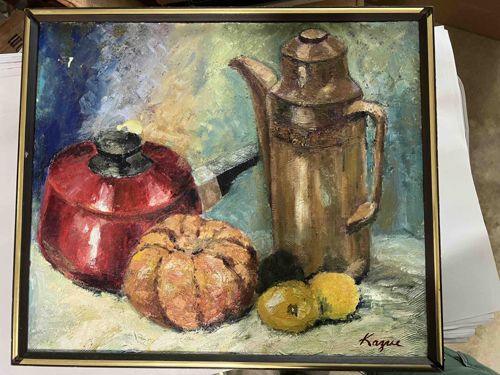
This is an oil painting depicting a still life scene, framed in a thin, dark brown frame with a gold-toned inner edge. The artwork itself features a visible impasto technique, indicating thick application of paint, and brushstrokes are clearly discernible throughout the composition. The main subjects include a red, somewhat squat kettle or pot with a dark lid, positioned on the left side of the canvas. Adjacent to it, slightly towards the center, is a textured, round, orange-yellow fruit, possibly a pumpkin or a large citrus. On the right, a tall, slender brass or copper-toned teapot with a handle and spout is prominent. Two smaller, yellow, round fruits, appearing to be lemons or limes, are situated in the foreground, below the teapot. The background is a blend of cool tones, with blues and greens visible, suggesting a draped fabric or an abstract wall. The foreground surface beneath the items is rendered in lighter, almost white and grey tones, possibly a tablecloth. The artist's signature, "Kagree," is visible in script in the bottom right corner. The overall aesthetic suggests a mid-20th-century style, possibly from the 1950s to 1970s, characterized by expressive brushwork and a focus on color and texture rather than hyperrealism. There are no obvious signs of damage such as tears or significant paint loss visible in the image, and the frame appears intact with minor wear consistent with age. This piece exhibits good craftsmanship through its handling of light, shadow, and color, which gives depth and life to the still-life arrangement.
AI Appraisal Report
Upon visual examination of this still life oil painting, I assess its condition as good, consistent with its likely age. The impasto technique is clearly visible, and brushstrokes are discernible, indicating a deliberate artistic choice. There are no obvious signs of significant damage such as tears, paint loss, or egregious frame issues visible from the image. The frame itself, a thin dark brown with a gold-toned inner edge, appears intact with minor wear. The artist's signature, "Kagree," is present in the bottom right corner.
Authenticity of the signature and attribution cannot be definitively confirmed from an image alone. A physical inspection would allow for closer examination of brushwork, paint quality, and signature detail, eliminating the possibility of prints or reproductions. Provenance documentation, such as exhibition records, bills of sale, or artist's statements, would be crucial for establishing a verified history and authorship. Without such documentation, the artist's identity and market history remain unknown, which significantly impacts value.
Considering market conditions, still life paintings by unestablished or lesser-known artists typically command modest prices. Comparables in the secondary market for decorative yet well-executed oil paintings of this style by unidentified artists often fall within the $200-$600 range. While the craftsmanship is good, and the composition attractive, the lack of verifiable provenance or an established artist limits its potential for higher valuation. The mid-20th-century aesthetic (1950s-1970s) is generally appealing for home decor. Demand is moderate for such pieces, and rarity is difficult to assess without knowing the artist's output. Scientific testing, such as pigment analysis, would be needed to confirm the age and media, though this is typically reserved for higher-value works or cases of suspected forgery.