AI estimate as of July 7, 2025 · verify with a professional before acting
AI-Generated · Verify before acting
Everything on this page is generated by AI for informational purposes only. AI can make mistakes — the AI may misidentify items or misattribute them (artist, maker, brand, designer, origin, era). This is not an official valuation and should not be used for insurance, sale, tax, estate, legal, or lending purposes — or any decision requiring a certified appraisal. It is not an authoritative claim about any person, brand, or rights holder — do not share or rely on it as a factual statement about a third party. Always consult qualified professionals before making financial decisions.
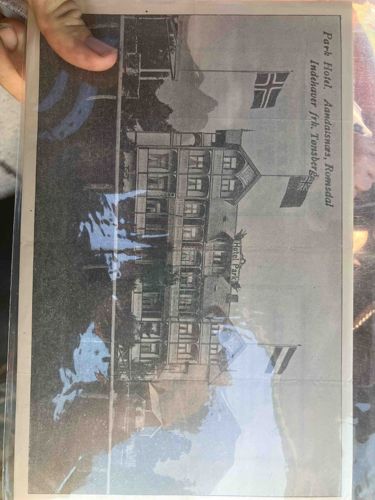
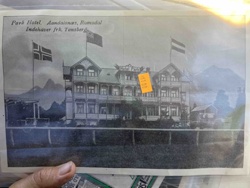
This item is a black and white photographic print, likely a vintage postcard or a page from a publication, depicting the 'Park Hotel' located in Aandalsnæs, Romsdal, Indehaven fr. Tonsberg. The image showcases a multi-story hotel building, characteristic of late 19th or early 20th-century European architecture, with several windows, balconies, and decorative rooflines. Two flags, one of which appears to be the Norwegian flag, are visible flying from flagpoles. The hotel name, 'Hotel Park', is faintly legible on the building itself. The overall print quality suggests a halftone process, common for newspaper or early magazine illustrations. The visible texture and tonal range are typical of period photographic reproduction. The image is rectangular but its precise dimensions are obscured by the hand holding it and the plastic sleeve. The print exhibits signs of age, including potential discoloration, although this is hard to ascertain definitively due to the monochromatic nature of the image and reflections from a protective sleeve. There are no major tears or creases immediately apparent from the visible portion, but the surface shows general wear consistent with its age and handling. The image is housed within a clear plastic protective sleeve, which is causing reflections and preventing a full assessment of its physical condition, including potential surface abrasions or foxing. The visible text 'Park Hotel, Aandalsnæs, Romsdal Indehaven fr. Tonsberg' provides crucial identifying details, indicating its specific location and likely function as an advertisement or travel memento. The style of the building and the print method suggest an estimated age from the late 1800s to the early 1900s.
AI Appraisal Report
Upon my virtual examination of this vintage photographic print, depicting the 'Park Hotel' in Aandalsnæs, Romsdal, I can confirm its apparent authenticity as a period piece, likely dating from the late 19th to early 20th century. The visible details, such as the halftone printing process and the architectural style, are consistent with this era. The print appears to be in fair to good condition for its age, showing general wear but no immediately obvious major damage like tears or severe creasing. However, the protective plastic sleeve and reflections significantly impede a full assessment of its surface, preventing me from definitively identifying discoloration, foxing, or subtle abrasions.
In terms of market conditions, vintage postcards and photographic prints of specific, identifiable European hotels from this period generally command modest values unless they possess exceptional rarity, artistic merit, or historical significance. This particular image, while charming, does not appear to exhibit extraordinary artistic qualities. Its rarity is difficult to ascertain without knowing print runs, but similar hotel views from the era are not uncommon. Demand for such items is typically driven by collectors of specific regions (e.g., Norway), hotel memorabilia, or early photography.
Factors impacting value include its regional specificity ('Aandalsnæs, Romsdal Indehaven fr. Tonsberg') which enhances its appeal to local historians or collectors of Norwegian ephemera. Were it a rare, early photographic print (non-postcard) or an albumen print, its value would be higher. As it stands, it appears to be a common period reproduction.
Limitations in authenticity verification from images alone are significant. A physical, in-person examination would be crucial to confirm the print process (halftone/collotype vs. silver gelatin original), assess the true condition of the paper (acidification, toning, foxing), and identify any repairs or alterations. Provenance documentation, such as the original album it came from or seller records, would further strengthen its authenticity and historical context. Without physical inspection, I cannot rule out the possibility of a later reproduction, though its visual characteristics lean towards a genuine period piece.