AI estimate as of July 27, 2025 · verify with a professional before acting
AI-Generated · Verify before acting
Everything on this page is generated by AI for informational purposes only. AI can make mistakes — the AI may misidentify items or misattribute them (artist, maker, brand, designer, origin, era). This is not an official valuation and should not be used for insurance, sale, tax, estate, legal, or lending purposes — or any decision requiring a certified appraisal. It is not an authoritative claim about any person, brand, or rights holder — do not share or rely on it as a factual statement about a third party. Always consult qualified professionals before making financial decisions.
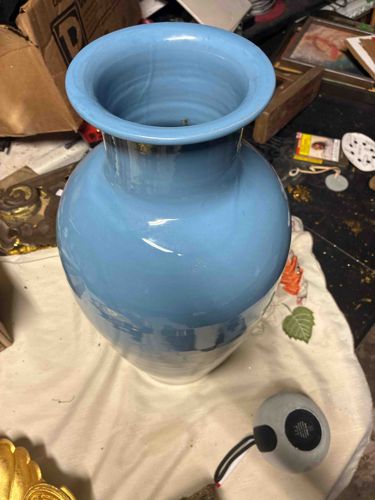
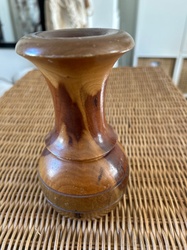
The item is a large, ceramic vase with a monochrome light blue glaze. Its form is robust, featuring a gracefully swelling body that tapers towards a defined neck and flares out into a substantial lip or rim. The glaze exhibits a high-gloss finish, reflecting ambient light prominently. There is a noticeable variation in the glaze application or firing across the surface, with some areas appearing slightly darker or more opaque, indicating potential pooling or thickness differences, particularly around the shoulder and neck where a subtle dark band is visible. The interior of the vase is also glazed in the same light blue hue, showing concentric rings that suggest it was thrown on a potter's wheel, characteristic of traditional ceramic production. The rim is thick and rounded, contributing to the vase's sturdy appearance. While no specific maker's marks, signatures, or stamps are discernible from the provided image, the overall craftsmanship appears competent. There are no obvious chips, cracks, or significant damage visible. The surface seems to be in good condition with a clean appearance, suggesting careful handling or recent cleaning. Without additional information or views, determining a precise style period is difficult, but its classic shape and solid color suggest a timeless design that could range from mid-20th century to contemporary production. The material is likely earthenware or stoneware due to its opaque nature and typical ceramic characteristics. Its considerable size, implied by its presence on what appears to be a tabletop or floor space, makes it suitable as a floor vase or a prominent centerpiece.
AI Appraisal Report
Upon examining the provided image of the Light Blue Glazed Ceramic Vase, I assess its condition as excellent. There are no visible chips, cracks, or significant abrasions, and the high-gloss finish remains intact. The subtle variations in glaze thickness, particularly the darker band around the shoulder, appear to be inherent to its production and contribute to its artisanal character rather than being flaws. Authenticity, based solely on visual inspection, is challenging. The concentric rings inside strongly suggest it was wheel-thrown, indicative of traditional ceramic methods. However, without maker's marks, signatures, or provenance documentation, definitive authenticity as a piece from a renowned studio or period (e.g., mid-20th century studio pottery) cannot be confirmed. An in-person examination would allow for tactile assessment of the clay body, glaze texture, and a thorough search for any hidden marks or repairs. Scientific testing, such as thermoluminescence dating, could potentially narrow down its age if a specific historical period is suspected.
In terms of market conditions, large monochrome ceramic vases with classic forms tend to hold steady appeal. Comparables often include studio pottery and mass-produced decorative items. Given its substantial size and good condition, it possesses strong decorative appeal. However, without established provenance or a recognized maker, it falls into the category of decorative art rather than fine art pottery, limiting its top-tier value. Demand for such pieces is consistent for interior design purposes. The primary factor impacting its value is the lack of identifying marks; if it were attributed to a known artist or pottery, its value would significantly increase. As it stands, it’s a well-executed decorative piece.