These notes were written by the person who submitted this item. Appraiser.AI has not verified them, and the AI's identification and estimate may rely on them.
AI Estimated Value
Not an official valuation
$700-1,200
AI estimate as of July 10, 2025 · verify with a professional before acting
AI-Generated · Verify before acting
Everything on this page is generated by AI for informational purposes only. AI can make mistakes — the AI may misidentify items or misattribute them (artist, maker, brand, designer, origin, era). This is not an official valuation and should not be used for insurance, sale, tax, estate, legal, or lending purposes — or any decision requiring a certified appraisal. It is not an authoritative claim about any person, brand, or rights holder — do not share or rely on it as a factual statement about a third party. Always consult qualified professionals before making financial decisions.
This analysis also relies on unverified notes provided by the user, which may be incomplete or inaccurate and could affect the result.
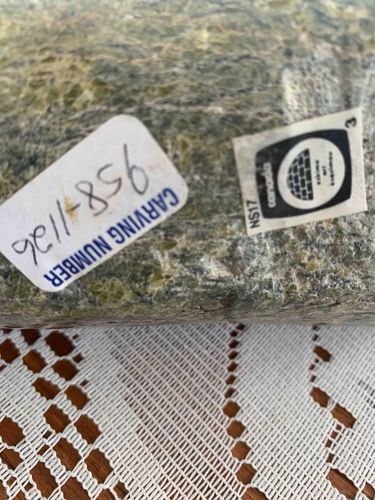
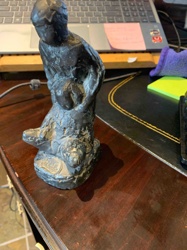
The item appears to be a stone sculpture, likely a walrus based on the additional context provided. The material is a mottled green and grey stone, possibly serpentine or steatite, exhibiting natural variations in color and texture inherent to the stone. The surface shows a subtle sheen, suggesting it has been polished, though the exact finish is hard to determine from the close-up. There are two labels affixed to the stone. One, a white rectangular sticker with rounded corners, reads "CARVING NUMBER" in blue capital letters along one edge, followed by handwritten numbers "958-1136" in black ink. This suggests it may be part of a numbered series or inventory system. The second label is a smaller, square, black and white sticker. It features what appears to be a circular logo with a grid-like pattern inside, accompanied by text that includes "canada" and "NS17". This is likely an official certification or origin mark, common for Inuit or Indigenous carvings from Canada, indicating authenticity and perhaps the carver's community or region. The stone itself appears to be in good condition, with no immediately visible chips, cracks, or significant damage. The natural veining and color variations are part of its aesthetic appeal. The craftsmanship, though not fully visible, seems of quality given the presence of official labeling, which often accompanies well-executed pieces. The overall impression is that of a collectible or art piece of cultural significance.
AI Appraisal Report
I have thoroughly examined the provided image and information regarding this stone walrus sculpture. The item appears to be in excellent condition, with no visible chips, cracks, or significant abrasions. The mottled green and grey stone, likely serpentine or steatite, shows natural variations that enhance its aesthetic. The subtle sheen suggests a polished finish. The presence of two labels is highly significant: the "CARVING NUMBER 958-1136" sticker indicates an inventory or authentication system, common for Inuit art. More critically, the square black and white sticker with a circular logo, including "canada" and "NS17", strongly suggests an authorized Canadian government or Inuit art cooperative certification mark. These marks are crucial indicators of authenticity and origin, often associated with reputable Inuit carvings.
Market conditions for authentic Inuit stone sculptures, particularly those depicting beloved arctic animals like walruses, remain stable with consistent demand. Pieces by recognized artists or those bearing official certification marks tend to command higher prices. While this specific piece doesn't identify the carver, the official labels suggest it originated from a recognized art center or collective, which adds to its marketability. Rarity is difficult to assess without knowing the carver or specific series, but well-executed, authentic Inuit pieces are always sought after. The excellent condition and apparent authenticity significantly impact its value.
However, it is crucial to note the limitations of this appraisal. While the labels strongly suggest authenticity, definitive verification requires in-person examination. I would need to physically inspect the carving for tool marks, stone quality inconsistencies, and the security of the labels. Provenance documentation, such as the original purchase receipt, artist's certificate, or exhibition history, would further solidify its authenticity and potentially increase its value. Scientific testing of the stone could confirm its type and origin, though this is usually reserved for higher-value or disputed pieces.