These notes were written by the person who submitted this item. Appraiser.AI has not verified them, and the AI's identification and estimate may rely on them.
AI Estimated Value
Not an official valuation
$150-300
AI estimate as of August 28, 2025 · verify with a professional before acting
AI-Generated · Verify before acting
Everything on this page is generated by AI for informational purposes only. AI can make mistakes — the AI may misidentify items or misattribute them (artist, maker, brand, designer, origin, era). This is not an official valuation and should not be used for insurance, sale, tax, estate, legal, or lending purposes — or any decision requiring a certified appraisal. It is not an authoritative claim about any person, brand, or rights holder — do not share or rely on it as a factual statement about a third party. Always consult qualified professionals before making financial decisions.
This analysis also relies on unverified notes provided by the user, which may be incomplete or inaccurate and could affect the result.
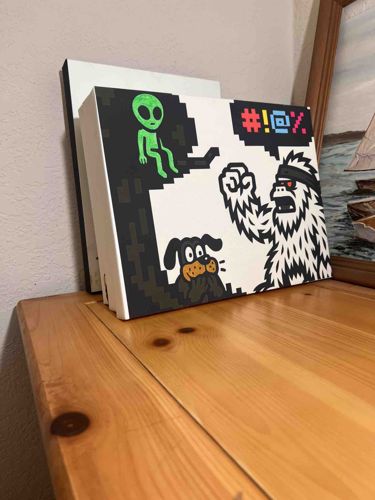
This item is a contemporary painting on canvas, likely acrylic on stretched canvas given its clean lines and vibrant colors. The overall dimensions appear to be small to medium, possibly around 12x12 or 16x16 inches, based on its proportion to the wooden surface it rests upon. The artwork features a distinct pixel-art or retro video game aesthetic, characterized by blocky, segmented forms and sharp edges, reminiscent of early digital graphics. The primary colors used are black, white, a bright lime green for the alien, and various vibrant colors (red, blue, yellow, pink, purple) for the speech bubble's expletive symbols. The composition depicts three figures: a lime green alien seemingly seated on a pixelated black structure resembling stairs or a platform, a shaggy white and black creature (possibly a yeti or monster) with a red bandanna across its eyes, its fist raised in an aggressive posture, and a black and brown dog-like creature with visible teeth, positioned between the alien and the larger creature. The 'speech bubble' above the large creature contains a collection of stylized profanity symbols commonly used in comics and video games to denote anger or frustration. The canvas itself appears to be in excellent condition with no visible damage, tears, or significant wear. The edges of the canvas are white, indicating either unpainted sides or a gessoed finish. The painting technique suggests a steady hand and precise application of paint, achieving crisp, defined lines between color blocks. There are no visible artist's signatures or marks on the front face. The style is distinctly modern, drawing heavily from pop culture and nostalgic digital aesthetics, suggesting it was created in the late 20th or early 21st century.
AI Appraisal Report
I have thoroughly examined the provided image and information regarding this pixel art painting, 'Alien, Yeti, and Dog.' Based on my visual assessment, the painting appears to be in excellent condition, showing no signs of tears, damage, or significant wear. The precise lines and vibrant colors suggest a well-executed piece, consistent with acrylics on stretched canvas. The 'Art shirt' detail, while implying association with merchandise, does not detract from the visual quality of the painting itself as a standalone work.
Authenticity, based purely on images, is always limited. While the style is clearly modern and draws from strong pop culture aesthetics, I cannot definitively verify the artist's identity or the piece's originality without in-person examination. A full authentication would require physical inspection to check for artist signatures (often located on the back or sides), examine the quality of the canvas and stretchers, and potentially cross-reference with known works or exhibitions of artists specializing in pixel art. Provenance documentation – details of the artist, purchase history, and exhibitions – would be crucial for establishing its market demand and rarity. Factors impacting value include the artist's reputation, the edition size (if it's a print or part of a series), and confirmed exhibition history. Without this information, it's challenging to assess its position within the contemporary art market comprehensively. Its appeal lies in its niche, pop-culture-driven aesthetic, which could attract a specific collector base interested in retro gaming or internet culture art. Due to the lack of identifying marks or provenance, it's currently valued more as decorative art than a collectible piece by a confirmed artist.