AI estimate as of October 12, 2025 · verify with a professional before acting
AI-Generated · Verify before acting
Everything on this page is generated by AI for informational purposes only. AI can make mistakes — the AI may misidentify items or misattribute them (artist, maker, brand, designer, origin, era). This is not an official valuation and should not be used for insurance, sale, tax, estate, legal, or lending purposes — or any decision requiring a certified appraisal. It is not an authoritative claim about any person, brand, or rights holder — do not share or rely on it as a factual statement about a third party. Always consult qualified professionals before making financial decisions.
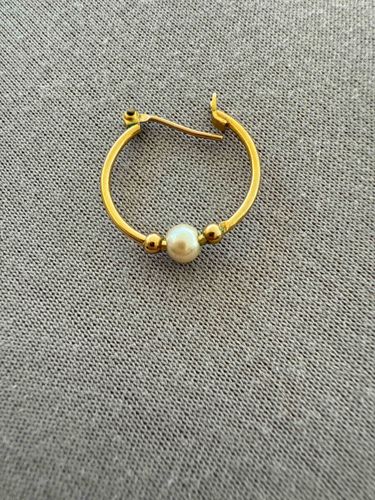
This item is a single, small hoop earring, appearing to be crafted from a gold-tone metal. The hoop itself is circular and relatively thin, approximately 1 mm in diameter for the hoop wire. It features a classic hinged closure mechanism, common in hoop earrings, where a thin wire or post from one end passes through a small loop or catch on the other end to secure it. The metal exhibits a bright, polished golden luster, suggesting either gold plating, gold-filled material, or possibly a base metal alloy with a gold finish. At the lowest curve of the hoop, three decorative elements are threaded onto the wire: a central, spherical pearl-like bead flanked on either side by a smaller, spherical gold-tone bead. The central pearl bead is off-white or cream in color, with a smooth, glossy surface, indicating either a cultured pearl, a faux pearl, or a glass bead with a pearlized coating. The two smaller gold-tone beads have a similar polished finish to the hoop itself. The craftsmanship appears to be standard for fashion jewelry, with no obvious signs of high-end artisanal work or intricate detailing beyond the basic construction. There are no visible maker's marks, signatures, or stamps in the provided image. The condition appears to be good, with no overt signs of wear, tarnishing, or damage visible, such as scratches, dents, or discolored plating. Based on its design, it likely dates from the late 20th century to contemporary times, possibly as part of a set of earrings, though only one is depicted. The simple yet elegant design makes it suitable for everyday wear.
AI Appraisal Report
Upon examining the provided image of this single gold-tone hoop earring with pearl and gold beads, I assess its condition as good. There are no visible signs of wear, tarnishing, or damage such as scratches, dents, or plating discoloration. Authenticity, based solely on visual inspection, points towards costume or fashion jewelry rather than fine jewelry. The absence of maker's marks or stamps, combined with the 'gold-tone' description, suggests a base metal construction with a gold finish, which is common for less expensive pieces. The 'pearl-like bead' is likely a faux pearl, glass with a pearlized coating, or a cultured pearl of lower grade. While the design is classic and elegant, the craftsmanship appears standard, lacking the intricate detailing often found in higher-value pieces.
Market conditions for single earrings of this type are generally low, as they are typically sold as pairs. Comparables would include similar gold-plated or gold-tone hoop earrings with synthetic pearls or accent beads from fashion jewelry retailers. Demand for such an item, especially as a single piece, is limited. Rarity is not a factor here; countless similar designs exist in the mass market. Factors significantly impacting value are the likely base metal composition, the probable faux nature of the pearl, and its status as a single earring. Had it been solid gold with a genuine cultured pearl and part of a pair, the value would be substantially higher.
It is crucial to note that without an in-person examination, definitive authentication is limited. To confirm material composition (e.g., gold plating thickness, base metal), spectrographic analysis or acid testing would be necessary. Microscopic examination would be required to determine if the pearl is natural, cultured, or imitation. Provenance documentation could also shed light on its origin and potential value as a branded item. Based on visible characteristics alone, I conclude it is a common fashion accessory.