These notes were written by the person who submitted this item. Appraiser.AI has not verified them, and the AI's identification and estimate may rely on them.
AI Estimated Value
Not an official valuation
$60-120
AI estimate as of July 15, 2025 · verify with a professional before acting
AI-Generated · Verify before acting
Everything on this page is generated by AI for informational purposes only. AI can make mistakes — the AI may misidentify items or misattribute them (artist, maker, brand, designer, origin, era). This is not an official valuation and should not be used for insurance, sale, tax, estate, legal, or lending purposes — or any decision requiring a certified appraisal. It is not an authoritative claim about any person, brand, or rights holder — do not share or rely on it as a factual statement about a third party. Always consult qualified professionals before making financial decisions.
This analysis also relies on unverified notes provided by the user, which may be incomplete or inaccurate and could affect the result.
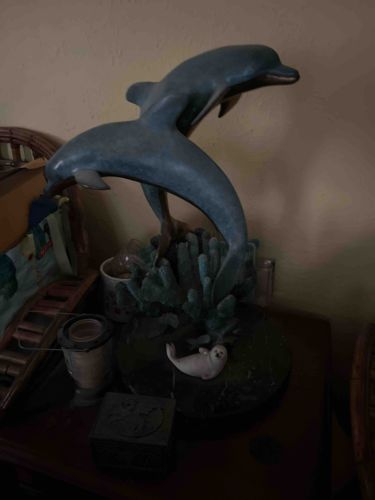
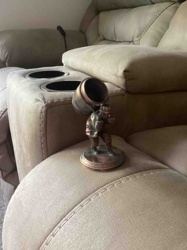
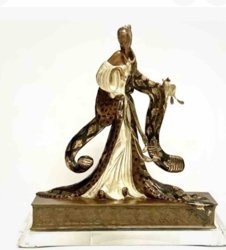
This item is a decorative sculpture depicting two dolphins leaping from what appears to be a coral or marine plant base. The sculpture is likely made of a cast material, possibly resin or a type of cold-cast bronze, given the matte, almost metallic blue-green finish reminiscent of aged copper or bronze with patina. The dolphins are dynamically posed, suggesting movement and interaction, with one dolphin higher than the other, as if emerging from the water. The base is irregular and textured, designed to mimic an underwater environment, with green and blue tones suggesting coral formations and possibly water. The overall size appears considerable, likely a foot or more in height, given the surrounding items. There are no clearly discernible maker's marks or signatures visible in the provided image. The style suggests a decorative, possibly mass-produced, item from the late 20th to early 21st century, often found in coastal-themed or nature-inspired home decor. The craftsmanship appears to be of decent quality for such a decorative piece, with smooth transitions and well-defined forms for the dolphins. There are no obvious signs of significant damage or repairs, though the lighting makes it difficult to assess minor scuffs or wear. The color palette is consistent and contributes to the marine theme.
AI Appraisal Report
I've examined the images of the 'Wayland statue,' which depicts two dolphins leaping from a coral-like base. The sculpture appears to be in good overall condition, with no overt signs of significant damage such as chips, cracks, or repairs visible in the provided image. The matte blue-green finish, suggestive of patinated bronze or aged copper, is consistent and visually appealing for its marine theme. The dynamic pose of the dolphins is well-executed, conveying a sense of movement.
Authenticity of the material and manufacturer, beyond what is visually apparent, is difficult to confirm from images alone. The "Wayland statue" attribution by the owner could refer to a manufacturer, artist, or retailer. Without a visible maker's mark or signature to corroborate this, its true origin remains unverified. This piece appears to be a decorative item, likely mass-produced, made from a cast material such as resin or cold-cast bronze. Such items are common in nature-themed or coastal decor.
Market conditions for decorative sculptures of this type are generally stable, with a broad supply. Comparables typically sell in the lower to mid-range for decorative art. Demand is driven by aesthetic appeal and thematic interest rather than artistic rarity or material intrinsic value. While the craftsmanship is decent, the lack of a known artist or high-value material limits its collectibility. Factors impacting value include its decorative appeal, good condition, and potential manufacturer if 'Wayland' signifies a reputable brand, though this cannot be confirmed without further examination.
For full authentication and a more precise valuation, a physical inspection would be crucial to confirm the material composition, assess weight, examine the underside for manufacturer's marks or labels, and detect any subtle imperfections not visible in photographs. Provenance documentation, such as purchase receipts or certificates, linking it to a specific manufacturer or collection, would also be invaluable.