Paleo-Indian Quartz Crystal Projectile Point
Native American Artifacts / Lithics

Paleo-Indian Quartz Crystal Projectile Point

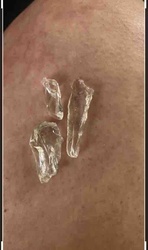
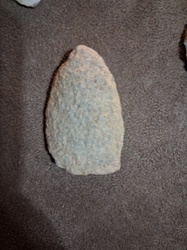
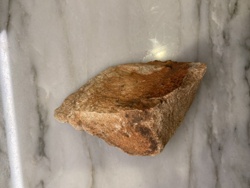
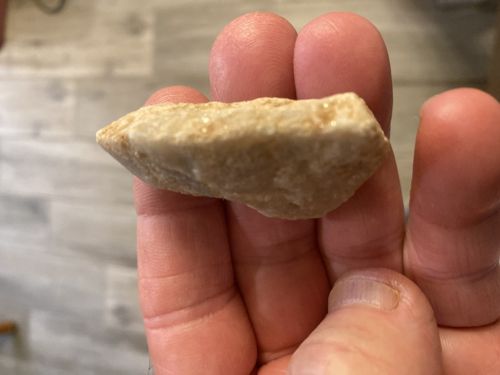
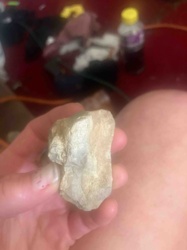
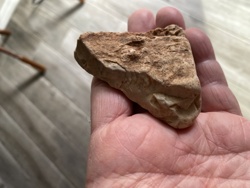
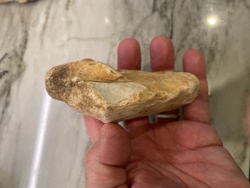
This is a lithic artifact identified as a projectile point or stone tool, measuring approximately 2 inches in length and 1.25 inches in width. It is masterfully knapped from a translucent to semi-opaque quartz crystal material, which is a particularly difficult medium to flake due to its internal crystalline structure and natural fractures. The artifact exhibits a milky white to light tan coloration with visible internal crystalline facets that catch the light. The shape is characterized by a broad, slightly asymmetrical body narrowing towards a point. The construction shows evidence of bifacial thinning, with distinct pressure flaking scars along the margins to create a sharp cutting edge. The cross-section appears relatively thick, which is common for quartz points. In terms of condition, the item displays a natural patina and softened edges consistent with long-term burial in Oklahoma soil. There are minor irregular chips along the distal end and base, likely resulting from ancient use-wear or environmental factors over millennia. This piece originated from the Paleo-Indian period, representing some of the earliest human craftsmanship in North America. The use of high-quality quartz crystal suggests a high level of technical skill and perhaps a cultural preference for visually striking lithic materials. The craftsmanship is robust, indicating it served as a functional tool despite the aesthetic quality of the stone.
Estimated Value

$450.00 - $750.00

Basic Information

Category

Native American Artifacts / Lithics

Appraised On

March 6, 2026

Estimated Value

$450.00 - $750.00

Additional Details Provided By Owner

User Provided Information

Paleo indian quartz crystal point found in Guthrie OK measuring 2" x 1.25"

Item Description

This is a lithic artifact identified as a projectile point or stone tool, measuring approximately 2 inches in length and 1.25 inches in width. It is masterfully knapped from a translucent to semi-opaque quartz crystal material, which is a particularly difficult medium to flake due to its internal crystalline structure and natural fractures. The artifact exhibits a milky white to light tan coloration with visible internal crystalline facets that catch the light. The shape is characterized by a broad, slightly asymmetrical body narrowing towards a point. The construction shows evidence of bifacial thinning, with distinct pressure flaking scars along the margins to create a sharp cutting edge. The cross-section appears relatively thick, which is common for quartz points. In terms of condition, the item displays a natural patina and softened edges consistent with long-term burial in Oklahoma soil. There are minor irregular chips along the distal end and base, likely resulting from ancient use-wear or environmental factors over millennia. This piece originated from the Paleo-Indian period, representing some of the earliest human craftsmanship in North America. The use of high-quality quartz crystal suggests a high level of technical skill and perhaps a cultural preference for visually striking lithic materials. The craftsmanship is robust, indicating it served as a functional tool despite the aesthetic quality of the stone.
Get Your Items Appraised

Instant estimates of your treasures with AI-powered instant appraisals

Browse More Appraisals