AI estimate as of September 1, 2025 · verify with a professional before acting
AI-Generated · Verify before acting
Everything on this page is generated by AI for informational purposes only. AI can make mistakes — the AI may misidentify items or misattribute them (artist, maker, brand, designer, origin, era). This is not an official valuation and should not be used for insurance, sale, tax, estate, legal, or lending purposes — or any decision requiring a certified appraisal. It is not an authoritative claim about any person, brand, or rights holder — do not share or rely on it as a factual statement about a third party. Always consult qualified professionals before making financial decisions.
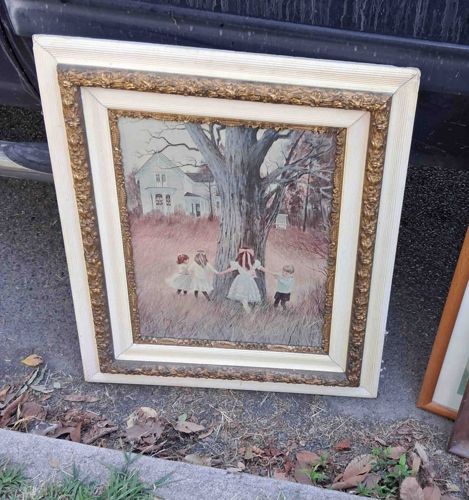
The item is a framed print or possibly a painting depicting a pastoral scene with children. The central motif is a large, mature tree, around the base of which three young children are standing, appearing to hold hands or interact. In the background, to the left, there is a traditional-style house with multiple windows, suggesting a rural or suburban setting. The overall color palette leans towards muted tones, with browns, greens, and a noticeable pinkish/purplish hue in the grass and sky, giving it an ethereal or nostalgic feel. The frame itself is substantial, featuring a wide, off-white or cream-colored outer section with a smooth, possibly gessoed or painted finish. This outer frame has visible mitered corners. Inside this, there is a richly detailed, antiqued gold-colored inner filet or liner, characterized by ornate raised patterns, possibly a floral or acanthus leaf motif, indicative of a decorative or traditional style. The print/painting shows some discoloration or fading, especially in the lighter pinkish tones in the foliage and ground, which might be a natural aging process or sun exposure. The frame appears structurally sound, though surface dirt and minor scuffs are visible, consistent with being placed outdoors as seen in the image. There are no obvious signs of significant damage like cracks or breaks to the frame, but closer inspection would be needed to assess the condition of the artwork itself for foxing, tears, or other degradation. The artistic style suggests a late 20th-century aesthetic, possibly aligning with popular decorative art of that period.
AI Appraisal Report
Based on my visual examination of the Framed Children and Tree Scene Print/Painting, it appears to be a decorative piece likely from the late 20th century. The muted color palette, particularly the pinkish/purplish hues, suggests a mass-produced print aiming for a nostalgic or ethereal aesthetic. The frame itself is substantial, with a wide, off-white outer section and an ornate gold-colored inner filet, typical of decorative framing styles of that era.
Concerning condition, the print shows signs of age, consistent with natural fading or potential sun exposure, particularly in the lighter tones. Surface dirt and minor scuffs are visible on the frame, as expected from an item of this age possibly displayed outdoors. No major structural damage to the frame is apparent from the image.
Authenticity: Without a signature or edition number, and given the likely decorative nature, it is difficult to ascertain if this is a standalone painting or a print without physical inspection. It strongly resembles a mass-produced print. Full authentication would require in-person examination to check for print dots, brushstrokes (if a painting), paper type, and any hidden markings. Provenance documentation, though unlikely for such an item, would confirm its history. Scientific testing is not typically warranted for an item of this type unless there were claims of significant artistic attribution.
Market Conditions, Demand, and Rarity: Items like this were widely produced for home decor. The market for general decorative prints from the late 20th century is modest. Demand is low unless there is a specific nostalgic appeal to a buyer. Rarity is not a factor here.
Factors impacting value: The primary value is decorative. Its condition, while acceptable, does not enhance value significantly. The lack of artistic attribution or rarity means its value is primarily as a used decorative item. It would appeal to someone looking for a specific aesthetic for their home.
Limitations: My assessment is based solely on the provided image. A physical inspection would be necessary to confirm if it’s a print or original painting, assess exact paper/canvas condition, and check for hidden marks or damage.