AI estimate as of September 25, 2025 · verify with a professional before acting
AI-Generated · Verify before acting
Everything on this page is generated by AI for informational purposes only. AI can make mistakes — the AI may misidentify items or misattribute them (artist, maker, brand, designer, origin, era). This is not an official valuation and should not be used for insurance, sale, tax, estate, legal, or lending purposes — or any decision requiring a certified appraisal. It is not an authoritative claim about any person, brand, or rights holder — do not share or rely on it as a factual statement about a third party. Always consult qualified professionals before making financial decisions.
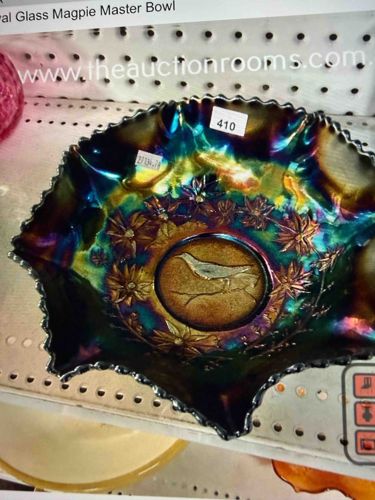
This is a captivating iridescent carnival glass master bowl, likely dating from the early 20th century, which is characteristic of the Art Nouveau or Edwardian era. The bowl features a vibrant, multi-hued iridescence, showcasing a rich interplay of blues, purples, greens, and golden-bronze tones that shift with the light, a hallmark of carnival glass. Its physical form is that of a shallow, wide bowl with an irregular, crimped, and ruffled edge, giving it a somewhat organic or floral appearance. The primary decorative element is a circular raised medallion in the center, which prominently displays a stylized bird perched on a branch. Surrounding this central motif is a band of intricately molded floral designs, possibly dahlias or similar large-petaled flowers, interspersed with foliage, all rendered in relief. The details of the bird and flowers are accentuated by the iridescent finish, which pools and highlights the contours. The underside of the bowl appears to have a more subdued iridescence, or is potentially a solid color that forms the base for the iridescent treatment on the interior. There are no immediately visible major condition issues such as cracks or significant chips, though typical age-related wear, light scratching, or minor flea bites on the rim are possible but not discernable from the image. The quality of craftsmanship is apparent in the detailed molding and the consistent application of the iridescent finish. The item appears to be in good, displayable condition.
AI Appraisal Report
Based on my visual examination of the provided image, this Iridescent Carnival Glass Master Bowl with a Bird and Floral Motif presents as an authentic piece of early 20th-century carnival glass. The vibrant, multi-hued iridescence, characteristic crimped and ruffled edge, and the raised molded bird and floral motifs are all consistent with glass produced during the Art Nouveau or Edwardian era by prominent manufacturers like Fenton, Northwood, or Dugan. The quality of the molding and the depth of the iridescent finish appear excellent from the image, suggesting good craftsmanship.
From the photograph, the bowl appears to be in good, displayable condition. I do not observe any significant cracks or chips. However, without a physical inspection, it is impossible to confirm the absence of minor flea bites on the rim, light surface scratching, or other age-related wear that would impact value. Such minor imperfections are common in glass of this age.
The market for carnival glass is generally stable, with specific patterns and colors commanding higher prices. This bird and floral motif, while attractive, is not among the rarest patterns. Similar master bowls in good condition typically fall within the $100-$200 range in today's market. Demand is consistent among collectors, especially for well-preserved examples with strong iridescence. Factors impacting value include the specific manufacturer (if identifiable), the rarity of the pattern and color combination, and crucially, the actual physical condition.
For full authentication and a definitive condition assessment, an in-person examination would be essential. This would allow me to check for manufacturer marks (which are often subtle or absent on early carnival glass), inspect for minute damage not visible in photographs, and assess the tactile quality of the glass. While the image strongly suggests authenticity, provenance documentation, if available, would further solidify its history and origin.