AI Appraisal Estimate

AI-generated estimates · not official valuations

From the user

What was submitted

Photo and notes provided by the user — not generated by AI

Submitted item photo
Submitted photo · May 22, 2026

User's notes

No additional notes provided.

AI analysis below

AI appraisal

AI analysis & estimate

AI-Generated · Verify before acting

Everything below is generated by AI for informational purposes only. AI can make mistakes — the AI may misidentify items or misattribute them (artist, maker, brand, designer, origin, era). This is not an official valuation and should not be used for insurance, sale, tax, estate, legal, or lending purposes — or any decision requiring a certified appraisal. It is not an authoritative claim about any person, brand, or rights holder — do not share or rely on it as a factual statement about a third party. Always consult qualified professionals before making financial decisions.

Read the full disclaimer

AI Identification

·Not independently authenticated·Verify before acting

Neoclassical Reclining Allegorical Figure Sculpture (likely Father Time or a River God)

Fine Art - Sculpture

AI Estimated Value

·Not an official valuation·Verify before acting

$1,800 - $2,600

As of May 22, 2026

AI Item Analysis

·AI can make mistakes·Verify before acting
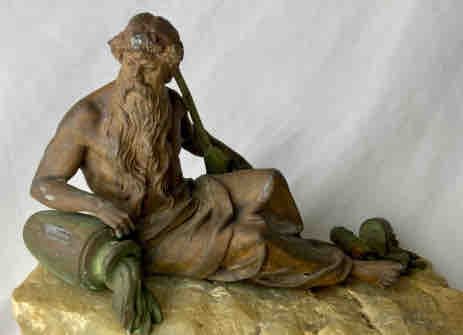
This is a detailed figurative sculpture depicting a muscular, bearded elderly man in a reclining pose, mounted on a solid rectilinear stone plinth. The figure is likely an allegorical representation of Father Time or a River God, evidenced by the flowing hair, full beard, and the overturned vessel (urn) from which fluid or vegetation appears to pour near his right hand. The sculpture appears to be crafted from cast metal, possibly bronze or spelter, with a complex variegated patina over the surface. The coloration ranges from deep earthy browns and terracottas to oxidized verdigris greens, particularly concentrated on the urn and base elements. Notable features include the detailed anatomical rendering of the brawny upper torso, deeply carved facial features, and the draping of the classical robe over his lower half. The figure holds a staff or scythe handle behind him, suggesting chronological symbolism. The craftsmanship exhibits high-quality nineteenth-century Neoclassical influence. Condition-wise, the piece shows significant signs of age and wear; there is a visible rectangular repair or label mark on the side of the urn, some chipping to the stone base, and surface abrasions that have exposed the underlying metal, especially on the right arm. No maker's marks are immediately visible in this view, though the style suggests a European foundry origin from the mid-to-late 1800s.

AI Appraisal Report

·AI can make mistakes·Verify before acting
I have examined the provided images of this Neoclassical figural sculpture, likely depicting a River God or Father Time. The casting demonstrates high-quality anatomical detail and a complex, multi-tonal patina characteristic of mid-to-late 19th-century European bronze or high-grade spelter. The presence of the overturned urn and the muscular torso strongly suggests a Neoclassical influence. While the patina is rich, I note visible surface abrasions on the right arm and a notable repair or loss on the urn, which, alongside the chips on the stone plinth, indicates moderate wear consistent with age. Market demand for large-scale allegorical bronzes remains steady among collectors of Grand Tour-style antiquities. Comparable 19th-century figures of similar scale and complexity typically realize prices between $1,500 and $3,500 at auction. The value is currently constrained by the visible condition issues and the lack of a visible foundry mark, which would typically command a premium if attributed to a known maker like Barbedienne. Authentication via digital image is inherently limited. To confirm this valuation, an in-person inspection is required to determine the metal's composition (heavy bronze vs. lighter zinc-based spelter) and to check the interior of the cast for foundry marks or signatures. Documentation regarding its provenance or original purchase would also significantly enhance the value. Scientific testing, such as a metal alloy analysis or a microscopic examination of the patina, would be necessary to definitively rule out 20th-century reproductions. Therefore, this estimate assumes the piece is an original 19th-century casting and not a later 'after' edition.

Get your items appraised

Instant estimates of your treasures with AI-powered appraisals

Browse More Appraisals