AI estimate as of July 25, 2025 · verify with a professional before acting
AI-Generated · Verify before acting
Everything on this page is generated by AI for informational purposes only. AI can make mistakes — the AI may misidentify items or misattribute them (artist, maker, brand, designer, origin, era). This is not an official valuation and should not be used for insurance, sale, tax, estate, legal, or lending purposes — or any decision requiring a certified appraisal. It is not an authoritative claim about any person, brand, or rights holder — do not share or rely on it as a factual statement about a third party. Always consult qualified professionals before making financial decisions.
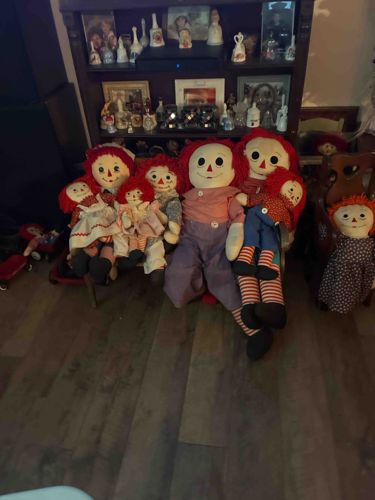
The image displays a collection of Raggedy Ann and Raggedy Andy dolls, ranging in various sizes, suggesting a family or series of these iconic characters. The dolls are primarily made from fabric, featuring the classic red yarn hair, button eyes (though some appear to be embroidered or painted to mimic a button look), and a distinctive triangular red nose. Their faces are typically simple with a red stitched smile. Physical characteristics vary depending on the doll's size; the largest doll appears to be around 2-3 feet tall, while the smaller ones are under a foot.
Several dolls are dressed in their traditional outfits: Raggedy Ann dolls are depicted in white aprons over patterned dresses (e.g., one doll is in a white dress with red rick-rack trim), and Raggedy Andy dolls are in blue trousers, striped socks, and a shirt (one visible in a pink shirt, another in a white shirt). The craftsmanship seems to be of a varied nature, indicating potential different manufacturers or different eras of production. Some dolls appear to be mass-produced, while others might be handmade or limited editions, given slight variations in facial features and clothing details.
Observable condition issues include some general wear consistent with age and handling, such as slight fading of fabrics, minor scuff marks, and possible loosening of seams or yarn hair on some dolls. There are no immediate signs of significant damage like tears or major repairs. The overall impression is good, suggesting they have been a cherished collection. The dolls likely date from the mid-to-late 20th century, given their traditional appearance, though without specific tags or maker's marks visible, a precise age is difficult to ascertain. The collection includes both male (Andy) and female (Ann) versions of the dolls, along with what appear to be smaller 'children' or companion dolls, adding to the visual narrative of a Raggedy family.
AI Appraisal Report
Based on my visual examination of the provided image, this collection of Raggedy Ann and Raggedy Andy dolls appears to be in good overall condition, consistent with age and typical handling. I observe variations in size, apparent craftsmanship, and slight differences in facial features and clothing, suggesting a mix of manufacturers or production eras, possibly mid-to-late 20th century. Authentication from images alone is limited; I cannot verify maker's marks, internal stuffing, or precise fabric composition. An in-person examination would allow for inspection of tags, seam quality, and fabric texture, crucial for definitive dating and manufacturer identification. Provenance documentation, such as purchase receipts or known collection history, would also significantly aid in authentication.
From a market perspective, Raggedy Ann and Andy dolls have a steady, albeit niche, demand, often driven by nostalgia. While individual common-era dolls typically fetch between $10-$50, a collection of varying sizes and apparent good condition holds more appeal. Rarity depends heavily on specific manufacturers, limited editions, or very early examples, which cannot be determined here. The varied nature and good presentation enhance collectibility. Factors impacting value include the diversity within the collection and the overall charming presentation, though the lack of identifiable rare pieces or strong provenance limits a higher valuation.
For a full authentication, I would require a physical inspection to check for specific production tags, assess fabric integrity, and possibly conduct ultraviolet light testing for repairs Invisible to the naked eye. Research into known manufacturers and their distinguishing features for these specific eras would also be vital.