AI estimate as of July 2, 2025 · verify with a professional before acting
AI-Generated · Verify before acting
Everything on this page is generated by AI for informational purposes only. AI can make mistakes — the AI may misidentify items or misattribute them (artist, maker, brand, designer, origin, era). This is not an official valuation and should not be used for insurance, sale, tax, estate, legal, or lending purposes — or any decision requiring a certified appraisal. It is not an authoritative claim about any person, brand, or rights holder — do not share or rely on it as a factual statement about a third party. Always consult qualified professionals before making financial decisions.
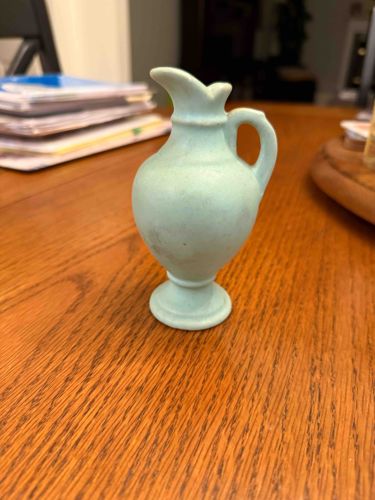
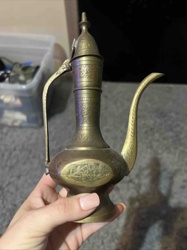
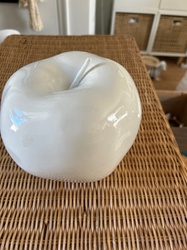
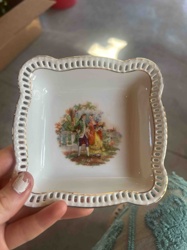
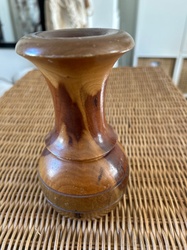
This is a small, light blue ceramic miniature pitcher or creamer. The item exhibits a matte, unglazed or very subtly glazed surface with a slightly textured, almost powdery appearance, consistent with a bisque or unpolished ceramic finish. The color is a soft, muted aqua or celadon green, suggesting a calming aesthetic. The pitcher features a bulbous body that tapers towards a narrow neck, which flares out into a graceful, wavy-edged spout designed for pouring. A single, C-shaped handle is attached to the side, maintaining the small scale of the piece. The base is pedestal-like, appearing as a stepped or tiered circular foot, elevating the main body of the pitcher. A thin, raised band circumnavigates the neck just below the spout, adding a subtle decorative element. There are no apparent chips, cracks, or significant abrasions visible, indicating good overall condition, although the matte finish makes minor surface wear difficult to distinguish without closer inspection. There are no discernible maker's marks, signatures, or specific manufacturing stamps visible in the provided images. The simplistic design and small scale suggest it could be a collectible, part of a dollhouse set, or a decorative accent piece. Its construction appears solid and the form is well-proportioned for its size, indicating decent craftsmanship, despite its likely mass-produced nature.
AI Appraisal Report
I have carefully examined the provided image of this miniature ceramic pitcher. From a visual standpoint, the item appears to be in very good condition, with no apparent chips, cracks, or significant abrasions. The matte, unglazed or subtly glazed surface is consistent and uniform. Authenticity cannot be definitively determined from images alone, but its simplistic design suggests it is likely a decorative collectible, possibly mass-produced, rather than a unique artisan piece. Without maker's marks or provenance, attributing it to a specific manufacturer or period is impossible.
In terms of market conditions, miniature decorative ceramics, especially those without clear identifying marks or historical significance, typically command modest prices. Comparables would include similar unmarked collectible mini pitchers or creamers found in antique malls, online marketplaces, or at estate sales. Demand for such generic items is generally low unless they are part of a highly sought-after collection or represent a rare design. This piece, while aesthetically pleasing, does not exhibit features indicating significant rarity. Factors impacting value are primarily its small size, lack of identifiable origin, and decorative rather than functional nature, placing it within the category of common curios.
To fully authenticate and assess provenance, an in-person examination would be crucial to analyze the ceramic body, assess specific glazing techniques, and check for any hidden marks. Research into similar items from specific periods or regions would also be beneficial to establish any potential historical context. Scientific testing, such as thermoluminescence dating, would be excessive and unwarranted for an item of this likely value. Provenance documentation, if available, would provide the most significant information regarding its origin and history.