AI estimate as of June 27, 2025 · verify with a professional before acting
AI-Generated · Verify before acting
Everything on this page is generated by AI for informational purposes only. AI can make mistakes — the AI may misidentify items or misattribute them (artist, maker, brand, designer, origin, era). This is not an official valuation and should not be used for insurance, sale, tax, estate, legal, or lending purposes — or any decision requiring a certified appraisal. It is not an authoritative claim about any person, brand, or rights holder — do not share or rely on it as a factual statement about a third party. Always consult qualified professionals before making financial decisions.
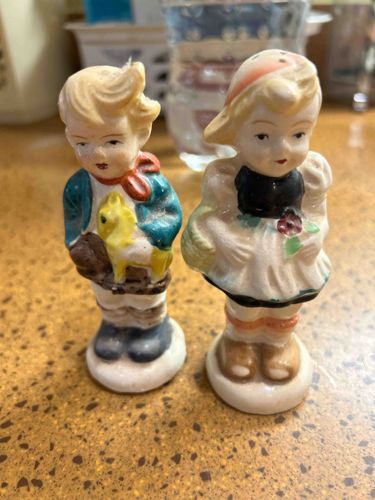
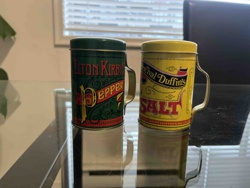
This is a pair of vintage ceramic salt and pepper shakers, depicting a boy and a girl. They appear to be made from glazed ceramic or porcelain, with hand-painted details. The boy figure has blonde hair, an orange-red bow tie, a teal/blue jacket, and is holding a small yellow animal, possibly a chick or small dog. He is wearing brown pants and blue-grey shoes. The girl figure has blonde hair, a pink head covering, a black collar, and a cream-colored dress with ruffles at the bottom. She is holding a small basket with purple and green floral accents. Her shoes are brown. Both figures show typical stylistic elements of mid-20th-century ceramic collectibles, characterized by soft colors and a somewhat idealized, childlike appearance. Each shaker has visible holes at the top for dispensing and a single larger hole on the bottom, typical for filling. While the specific maker's mark is not visible, these types of shakers were commonly produced in Japan or the USA during the 1940s-1960s. The paint shows minor wear and some slight inconsistencies, suggesting hand-painting rather than mass-produced decals. There are no obvious chips or cracks, but some light dirt accumulation, especially in crevices, and minor scuffs consistent with age and use. The bottoms of the shakers are white and appear to be slightly wider for stability, and they show some slight discoloration, indicative of their age. The craftsmanship is decent for novelty kitchenware of its era, with good detail in the facial features and clothing, despite some minor paint bleed.
AI Appraisal Report
Upon visual examination of the provided image, I assess this pair of vintage boy and girl ceramic salt and pepper shakers to be in good, unrestored condition for their age. There are no apparent chips or cracks, which is favorable. The minor paint wear, inconsistencies, and slight dirt accumulation are consistent with typical use and handling over decades, reinforcing their authenticity as genuine vintage pieces from the mid-20th century (likely 1940s-1960s). The hand-painted details and stylistic elements align with common production from Japan or the USA during that era, though a specific maker’s mark is not visible.
In terms of market conditions, vintage ceramic novelty salt and pepper shakers have a steady, albeit niche, collector's market. While not exceedingly rare, figural pairs like these, depicting children, do have a consistent demand among kitchenalia and ceramic collectors. Comparables on online marketplaces suggest similar pairs in good condition typically sell within a modest range. Factors impacting value include the lack of a known manufacturer's mark, which prevents them from commanding prices associated with renowned ceramic makers. However, their good condition and the charming, intact hand-painted details enhance their appeal.
For full authentication and a more precise valuation, an in-person examination would be crucial. This would allow for a thorough inspection for hairline cracks, crazing, or repairs (e.g., blacklight testing), and to check for hidden marks or specific production details on the base. Provenance documentation, if available, could also add significant value by confirming origin or history. Without physical inspection, I must state that certain fine details regarding condition and definitive attribution remain subject to further verification.