AI estimate as of December 13, 2025 · verify with a professional before acting
AI-Generated · Verify before acting
Everything on this page is generated by AI for informational purposes only. AI can make mistakes — the AI may misidentify items or misattribute them (artist, maker, brand, designer, origin, era). This is not an official valuation and should not be used for insurance, sale, tax, estate, legal, or lending purposes — or any decision requiring a certified appraisal. It is not an authoritative claim about any person, brand, or rights holder — do not share or rely on it as a factual statement about a third party. Always consult qualified professionals before making financial decisions.
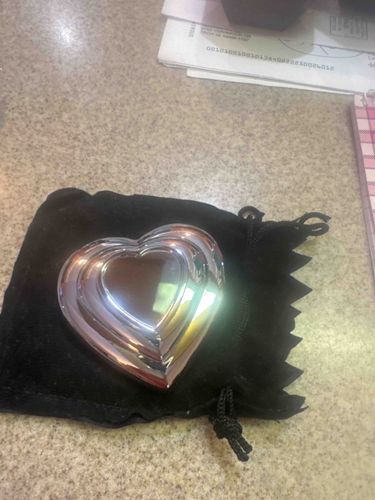
This item is a heart-shaped object, possibly a compact mirror or a small trinket box, crafted from a highly reflective, polished metal, likely chrome-plated brass, silver-plated metal, or stainless steel, given its bright, mirror-like finish. The predominant color is a brilliant silver tone, which reflects the surrounding environment. The top surface of the heart features a raised, layered, or stepped design, creating a three-dimensional effect. There is a distinct, smaller heart shape recessed within the larger heart outline, adding visual depth. The edges appear smooth and rounded, suggesting a comfortable feel in hand. The item is currently resting on a black, soft fabric pouch with a drawstring closure, which is partially visible at the bottom right, featuring a knotted cord. This pouch indicates it may be intended for protection or presentation. There are no visible manufacturer's marks, engravings, or significant condition issues such as dents, deep scratches, or tarnish, suggesting it is either well-maintained or relatively new. The smooth, lustrous surface and clean lines point to a modern or contemporary style, likely from the late 20th or early 21st century. The craftsmanship appears to be of good quality, with attention paid to the polished finish and the sculptural heart design. Its function as a compact would imply an opening mechanism and internal mirror/powder, while a trinket box would have a hinged lid and an open storage compartment; without further views, its exact utility remains speculative.
AI Appraisal Report
Upon visual examination of the provided image, I assess this heart-shaped object to be a decorative accessory, likely a compact mirror or a small trinket box, crafted from a highly reflective, silver-toned metal. The condition appears excellent; there are no discernible flaws such as dents, scratches, or tarnishing evident from the image, suggesting it is either new, very well-maintained, or saw minimal use. The modern, sleek design with its layered heart motif points to a contemporary origin, likely late 20th to early 21st century. The craftsmanship, particularly the polished finish and crisp lines, appears good for a mass-produced or small-batch item of this type.
Market conditions for non-branded, decorative metal compacts or trinket boxes are generally competitive. Similar items, often sold as gifts, souvenirs, or jewelry accessories, typically retail in the $20-$100 range, depending on material quality, specific design, and whether they are marketed as 'vintage' or 'designer-inspired.' Demand is moderate, driven by gifting occasions rather than serious collecting. Rarity is low; countless variations of heart-themed accessories exist.
The most significant factors impacting value are the unknown precise metal composition (e.g., base metal vs. sterling silver, which I cannot ascertain without physical inspection), the presence of any internal features (mirror, lining), and brand attribution. Without maker's marks, it is considered a generic decorative piece. Should this piece contain a high-quality mirror or be sterling silver, its value would be at the higher end or even exceed this range; however, based solely on visual cues, it appears to be a plated base metal.
Limitations in authenticity verification are significant. Without physical inspection, I cannot confirm the exact material (e.g., distinguishing between chrome-plated brass, silver-plated metal, or stainless steel), determine its weight, assess the functionality of any opening/closing mechanism, or search for hidden maker's marks or hallmarks. An in-person examination, potentially including magnet tests for base metal, spectroscopic analysis for precise metal identification, and assessment of internal components, would be necessary for full authentication and a more precise valuation. Provenance documentation, if available, could also significantly impact its perceived value, especially if linked to a known designer or manufacturer not immediately apparent.