AI estimate as of September 21, 2025 · verify with a professional before acting
AI-Generated · Verify before acting
Everything on this page is generated by AI for informational purposes only. AI can make mistakes — the AI may misidentify items or misattribute them (artist, maker, brand, designer, origin, era). This is not an official valuation and should not be used for insurance, sale, tax, estate, legal, or lending purposes — or any decision requiring a certified appraisal. It is not an authoritative claim about any person, brand, or rights holder — do not share or rely on it as a factual statement about a third party. Always consult qualified professionals before making financial decisions.
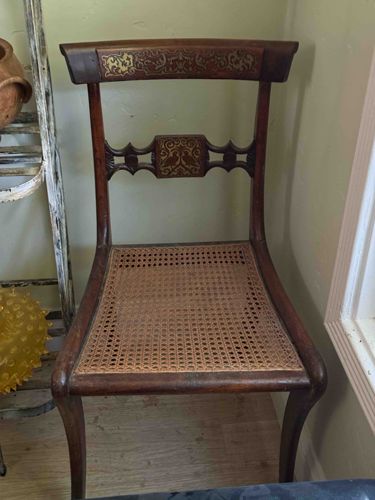
This is a single side chair, exhibiting characteristics consistent with a Regency or early Victorian style, likely dating from the mid-19th century. The chair is constructed from a dark-stained wood, possibly mahogany or a similar fruitwood, with a rich, aged patina. Its overall silhouette is elegant and somewhat delicate, suggesting it may have been part of a larger dining set or an occasional chair. A notable feature is the intricate decorative inlay work visible on both the top rail of the backrest and a horizontal central splat. The inlay on the top rail appears to be a continuous scrolling floral or foliate design, executed in what looks like a lighter wood or possibly brass or gilded material, standing out against the darker wood. The central splat features a more concentrated, symmetrical inlaid pattern, possibly depicting stylized birds or griffins facing each other amidst scrolling motifs, flanked by carved or pierced elements that give it a somewhat Gothic revival feel. The back posts are gracefully curved, leading to a gently curved crest rail. The seat is hand-caned, showing a traditional basketweave pattern, which appears to be in good, intact condition with no obvious breaks or sagging. The frame of the cane seat is slightly curved at the front, adding to the chair's refined aesthetic. The front legs are gently tapered and slightly curved, while the rear legs are simpler, also gently curved. The craftsmanship appears to be of good quality, with attention paid to the decorative details and overall form. Visible condition issues include some minor wear and scratches consistent with age and use on the wooden frame, particularly along edges and feet, but no severe damage, repairs, or structural integrity issues are immediately apparent. The dark finish has mellowed over time, enhancing its antique appeal. The chair's design reflects a period when classical influences were interpreted with decorative flair a precursor to early Victorian eclecticism.
AI Appraisal Report
This Regency-Style Cane Seat Side Chair with Inlay appears to be a good example of early to mid-19th century craftsmanship, likely dating between 1820 and 1850, exhibiting characteristics of both late-Regency and nascent Victorian styles. The dark-stained wood, possibly mahogany or a fruitwood, shows an appropriate aged patina consistent with its presumed age. The hand-caned seat is remarkably intact, which is a significant positive for its condition. The intricate inlay work on the crest rail and central splat, with its scrolling foliate and stylized bird motifs, is a key decorative element and appears well-preserved from the image; it likely uses lighter wood or brass inlay, which would need in-person confirmation. While minor wear and superficial scratches are visible, consistent with age and use, no major structural damage or repairs are apparent. The craftsmanship, particularly in the delicate curves and inlay, suggests a quality piece. Authenticity as a period piece seems highly probable based on style, construction cues, and patination visible in the image.
Limitations: Without physical inspection, I cannot confirm the exact wood species, the material of the inlay, or definitively rule out hidden repairs, woodworm, or structural weaknesses not evident from photographs. A close examination would also be needed to verify the age and craftsmanship of the caning.
Market Conditions and Comparables: The market for single antique side chairs, even well-appointed ones, can be soft unless part of a desirable set. Demand for Regency and early Victorian pieces remains steady but not exceptionally high for individual items like this. Comparables suggest a range for such chairs, with condition and intricacy of inlay being key value drivers. This chair's attractive overall condition and decorative inlay place it on the higher end for a single side chair of this type. Rarity is moderate; while not unique, such well-preserved examples with good inlay are not commonplace.
Factors impacting value: The intact caning, attractive inlay, and good overall condition positively impact the value. Its potential as a decorative accent piece or an occasional chair also helps. If this were part of a complete dining set, its value would be significantly higher per chair. Based on these factors, I would place the appraisal value between $350 and $550.