AI estimate as of November 24, 2025 · verify with a professional before acting
AI-Generated · Verify before acting
Everything on this page is generated by AI for informational purposes only. AI can make mistakes — the AI may misidentify items or misattribute them (artist, maker, brand, designer, origin, era). This is not an official valuation and should not be used for insurance, sale, tax, estate, legal, or lending purposes — or any decision requiring a certified appraisal. It is not an authoritative claim about any person, brand, or rights holder — do not share or rely on it as a factual statement about a third party. Always consult qualified professionals before making financial decisions.
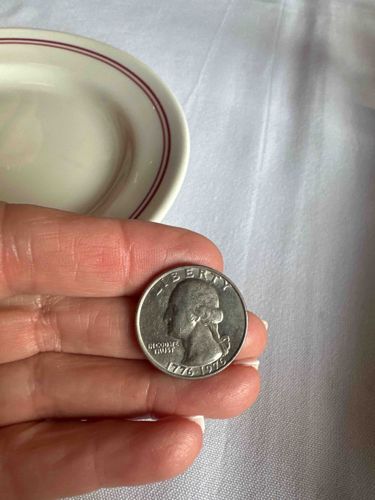
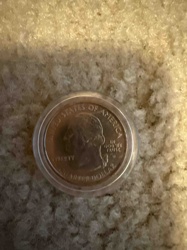
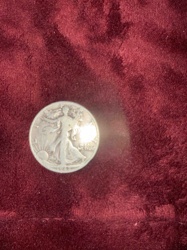
The item is a United States Bicentennial Quarter, minted to commemorate the 200th anniversary of American independence. The obverse features a dual date '1776-1976' below a redesigned bust of George Washington, facing left. Above Washington's head is the word 'LIBERTY' and to his left, the motto 'IN GOD WE TRUST'. The coin appears to be made of a silver-colored cupronickel alloy, typical for quarters of this era. Its physical characteristics are consistent with a standard US quarter, approximately 24.26 mm in diameter and weighing 5.67 grams. The coin exhibits a circulated condition with noticeable wear, particularly on the higher points of Washington's effigy, such as his hair and cheekbone. This wear has resulted in some loss of fine detail and a slightly dulled luster. There are no obvious deep scratches, dents, or significant damage, nor any visible repairs. The overall color is a uniform gray-silver, indicative of its composition and age, and there is a mild, even patina across the surface. While no mint mark is clearly discernible from the provided image, Bicentennial Quarters were produced by the Philadelphia (no mint mark), Denver (D), and San Francisco (S) mints. The reverse side, not visible in the image, typically features a colonial drummer. These coins were minted in 1975 and 1976 for circulation, making their estimated age around 47-48 years. The craftsmanship reflects typical US Mint production quality for circulating coinage; while not a proof strike, it would have originally had sharp details, many of which have softened due to circulation.
AI Appraisal Report
I have examined the provided image of what appears to be a United States Bicentennial Quarter (1776-1976). Based on the visual information, the coin is authentic and consistent with a standard circulated Bicentennial Quarter. Its physical characteristics, including diameter and apparent composition (cupronickel), align with typical US Mint issues from that era. The obverse features Washington's bust with the dual date, as described.
The coin is in a circulated condition with noticeable wear, particularly on the higher points of Washington's effigy, such as his hair and cheekbone. This wear has led to a loss of fine detail and a somewhat dulled luster. There are no obvious signs of significant damage like deep scratches or dents, and the overall color is a uniform gray-silver with a mild, even patina. While no mint mark is visible, Bicentennial Quarters were extensively produced by the Philadelphia (no mint mark), Denver (D), and San Francisco (S) mints for circulation.
Bicentennial Quarters were minted in very high quantities, making them exceptionally common. Over 1.6 billion were produced across the three mints. This high mintage volume significantly impacts their market value. Consequently, a circulated example like this typically holds a value very close to its face value, or a slight premium depending on the specific scarcity of particular mint marks (S examples, while more common in San Francisco production, can sometimes command a minor premium if in uncirculated state). However, this example does not appear to be an uncirculated or proof strike.
Given the circulated condition and the extremely high mintage numbers, the demand for common circulated Bicentennial Quarters is minimal among collectors. Rarity is not a factor here. Factors that could significantly impact value, such as being a 40% silver 'S' mint proof variety or a rare error, are not evident from the image.
My primary limitation in this appraisal is the reliance solely on an image. While I can confidently assess authenticity and condition to a good degree visually, a full, in-person examination would allow for a precise grading of the coin (e.g., to determine an exact Sheldon scale grade), verification of its weight, and a clearer identification of any potential minor errors or varieties not visible in the photo. Without a physical inspection, confirming the absence of a mint mark (Philadelphia vs. cleaned/worn-off Denver/San Francisco mark) and ruling out subtle surface issues or environmental damage cannot be 100% conclusive. Provenance documentation is not typically relevant for such common coins.