AI estimate as of December 5, 2025 · verify with a professional before acting
AI-Generated · Verify before acting
Everything on this page is generated by AI for informational purposes only. AI can make mistakes — the AI may misidentify items or misattribute them (artist, maker, brand, designer, origin, era). This is not an official valuation and should not be used for insurance, sale, tax, estate, legal, or lending purposes — or any decision requiring a certified appraisal. It is not an authoritative claim about any person, brand, or rights holder — do not share or rely on it as a factual statement about a third party. Always consult qualified professionals before making financial decisions.
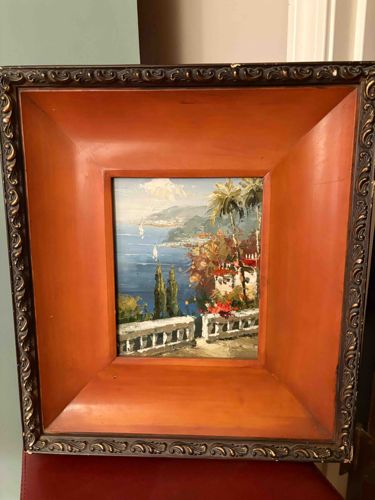
This item is a framed oil painting depicting a vibrant Mediterranean seascape. The painting itself is a relatively small rectangular format, likely on canvas or board, featuring a coastal town nestled by the sea with mountains in the background. Key elements in the artwork include several sailing vessels on the blue water, lush green cypress trees and palm trees, and colorful flora (hints of red and orange) around white-stuccoed buildings. A prominent feature in the foreground is a white balustrade or railing, suggesting a vantage point overlooking the scene. The brushwork appears to be impasto, with noticeable texture from the thickly applied paint, adding to the vibrancy and depth of the scene. The colors are rich and warm, with prominent blues, greens, and earthy tones. The painting is housed within a substantial frame composed of two distinct parts: an inner wide, smooth, sloped wooden liner in a warm reddish-brown or burnt orange finish, and an outer ornate, dark-colored (likely dark brown or black with gold accents) molded frame. The outer frame features intricate, continuous scrollwork or foliate patterns. There are minor signs of wear visible on the outer frame, such as small chips or abrasions, particularly noticeable in the upper right corner, typical for an item of some age. The overall condition appears good, with no overt damage to the painting itself discernible from the image. The style suggests a traditional or perhaps mid-20th century to contemporary approach to landscape painting, possibly produced as decorative art. No visible artist's signature or specific manufacturing marks are apparent from the provided image.
AI Appraisal Report
I have examined the provided image of this Framed Mediterranean Seascape Oil Painting. The artwork depicts a picturesque coastal town with notable impasto brushwork, suggesting a vibrant, textured surface. The depiction includes sailing vessels, lush trees, colorful flora, and white-stuccoed buildings, all rendered in rich, warm colors. A prominent white balustrade in the foreground grounds the composition. The painting is housed in a substantial two-part frame: an inner wide, sloped wooden liner in a warm reddish-brown, and an ornate dark outer frame with continuous scrollwork. The overall condition of the painting appears good, with no discernible damage. The outer frame, however, shows minor wear consistent with age, specifically chips and abrasions in the upper right corner. This style is consistent with decorative fine art, likely from the mid-20th century to contemporary period.
Authenticity cannot be fully verified from an image alone. While the brushwork and subject matter are appealing, the absence of a visible artist’s signature or any provenance documentation restricts a higher valuation based on attributed authorship. Many similar decorative Mediterranean scenes were produced without prominent artist attribution. The demand for such attractive, decorative pieces remains steady, though their rarity is low due to widespread production. The primary factors impacting value here are its decorative appeal, good condition, and the attractive, well-matched frame.
For full authentication, an in-person examination would be critical to assess the canvas/board type, paint consistency, and potential hidden signatures. Provenance documentation, including purchase history or exhibition records, would be essential to establish authorship and potentially increase value significantly. Scientific testing, such as pigment analysis, could help date the artwork more precisely if needed.