AI estimate as of October 17, 2025 · verify with a professional before acting
AI-Generated · Verify before acting
Everything on this page is generated by AI for informational purposes only. AI can make mistakes — the AI may misidentify items or misattribute them (artist, maker, brand, designer, origin, era). This is not an official valuation and should not be used for insurance, sale, tax, estate, legal, or lending purposes — or any decision requiring a certified appraisal. It is not an authoritative claim about any person, brand, or rights holder — do not share or rely on it as a factual statement about a third party. Always consult qualified professionals before making financial decisions.
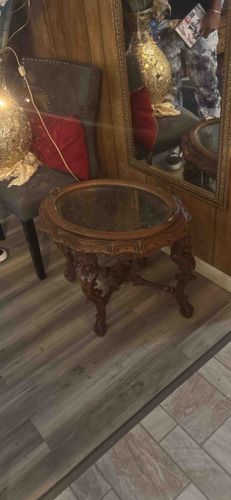
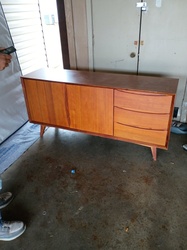
This appears to be an antique or vintage oval side table crafted from dark-stained wood, possibly mahogany or a similar hard wood, showcasing extensive and intricate carving work. The tabletop features a removable or inset clear glass panel, revealing the wooden surface below, which likely has decorative carving or a polished finish. The frame surrounding the glass is also carved with continuous curvilinear motifs, possibly featuring floral or foliate elements. The table stands on four legs, each heavily carved with elaborate designs, including what seem to be acanthus leaves, scrollwork, and perhaps mascarons or stylized animal forms, though clarity is limited. The legs are connected by a stretcher or lower shelf that is similarly carved, adding to the structural stability and decorative appeal. The overall color is a deep reddish-brown, indicative of a dark wood stain or natural aging. The craftsmanship appears to be of high quality, with fine details discernible in the carving. There are no obvious signs of significant damage such as large breaks or missing pieces, but typical wear consistent with age, such as minor scratches, scuffs to the wood finish, and potential dulling of the glass surface might be present upon closer inspection. The style suggests a Victorian or early 20th-century aesthetic, possibly influenced by Rococo revival or Gothic revival designs, characterized by its ornate and classical motifs. The table's dimensions appear to be suitable for a side table or occasional table, likely standing around 2-2.5 feet tall and about 2-3 feet in its longest dimension. The intricate carving is a key quality indicator, suggesting skilled artisan work.
AI Appraisal Report
Upon visual examination of the provided image, this Carved Wood and Glass Top Oval Side Table appears to be a high-quality antique or vintage piece, likely dating from the late 19th to early 20th century. The extensive and intricate carving throughout, particularly on the legs and stretcher, suggests skilled craftsmanship and a Rococo or Gothic Revival influence. The dark reddish-brown wood, potentially mahogany or a similar hardwood, exhibits a rich patina consistent with age. The presence of a clear glass top insert is a practical feature that would have protected the underlying carved surface.
Condition appears very good for its age, showing no obvious major damage like large breaks or repairs. I anticipate typical wear consistent with age, such as minor scratches, scuffs to the wood finish, and potential dulling or small chips to the glass edge, which would only be verifiable through in-person inspection. The quality of the carving is a significant value driver, indicating a higher-end production for its period.
Market conditions for ornate antique furniture have fluctuated, but well-preserved, finely carved pieces like this continue to attract demand from collectors and decorators seeking unique accent pieces. Comparables for similar elaborately carved side tables of the period typically fall within the $500-$1,200 range, depending on wood species, exact period, and provenance. This table's intricate detail likely places it at the mid-to-higher end of that spectrum.
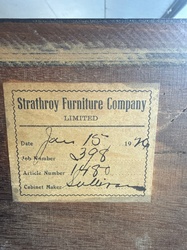
Limitations in authenticity verification from images alone include inability to assess wood quality, joinery, and the presence of any repairs or alterations beneath the surface. Full authentication would require a hands-on examination to inspect construction methods, wood grain, tool marks, and any maker's marks, as well as checking for signs of modern replication or extensive restoration. Provenance documentation, if available, would further enhance its historical and market value.