These notes were written by the person who submitted this item. Appraiser.AI has not verified them, and the AI's identification and estimate may rely on them.
AI Estimated Value
Not an official valuation
$50-80
AI estimate as of July 5, 2025 · verify with a professional before acting
AI-Generated · Verify before acting
Everything on this page is generated by AI for informational purposes only. AI can make mistakes — the AI may misidentify items or misattribute them (artist, maker, brand, designer, origin, era). This is not an official valuation and should not be used for insurance, sale, tax, estate, legal, or lending purposes — or any decision requiring a certified appraisal. It is not an authoritative claim about any person, brand, or rights holder — do not share or rely on it as a factual statement about a third party. Always consult qualified professionals before making financial decisions.
This analysis also relies on unverified notes provided by the user, which may be incomplete or inaccurate and could affect the result.
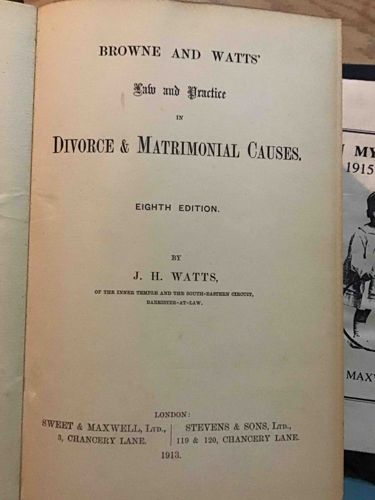
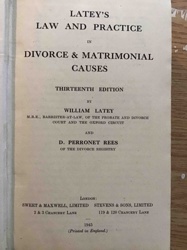
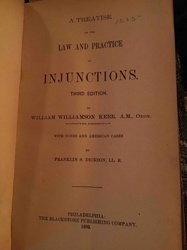
The item is the title page of a legal textbook, specifically the 'Eighth Edition' of 'BROWNE AND WATTS' Law and Practice in DIVORCE & MATRIMONIAL CAUSES.' The page is made of aged, light cream or off-white paper, typical of publications from the early 20th century. The text is printed in black ink, featuring a mix of serif and ornate script fonts. The primary title 'BROWNE AND WATTS' uses a clear, classic serif typeface, while 'Law and Practice' is rendered in a more decorative, old-style script. The significant part 'DIVORCE & MATRIMONIAL CAUSES' is prominently displayed in a bold, large serif font. Below this, 'EIGHTH EDITION.' indicates its revised status. The author is identified as 'J. H. WATTS, OF THE INNER TEMPLE AND THE SOUTH-EASTERN CIRCUIT, BARRISTER-AT-LAW.' Publishing details at the bottom state 'LONDON:' with two publishers listed: 'SWEET & MAXWELL, LTD., 3, CHANCERY LANE' and 'STEVENS & SONS, LTD., 119 & 120, CHANCERY LANE'. The publication year, '1913', is clearly visible at the very bottom. The paper exhibits some minor creasing or warping along the left edge, consistent with being part of a bound volume. There are no major tears or stains visible, and the printing is clear and legible. A slight discoloration or foxing may be present due to age, but overall it appears to be in good condition, retaining its structural integrity and readability, which speaks to good quality paper and binding for its time.
AI Appraisal Report
Based on my examination of the provided image, the title page of 'BROWNE AND WATTS' Law and Practice in DIVORCE & MATRIMONIAL CAUSES, Eighth Edition (1913)' appears to be in good condition. The paper shows age-appropriate light cream color with no major tears or stains, and the printing is clear and legible. Minor creasing or warping along the left edge is consistent with a bound volume from the era. The typography and printing details align perfectly with known publishing practices of Sweet & Maxwell and Stevens & Sons from 1913, lending strong visual support to its authenticity.
Legal textbooks from this period, especially those covering specific and historically significant areas like divorce law, have a niche market. While not exceedingly rare, an early 20th-century legal text in genuinely good condition, as this appears to be, holds value for legal historians, collectors of vintage books, and institutions. The 'Eighth Edition' status suggests its continued relevance and updates at the time, which can enhance its historical significance. Market comparables for similar well-preserved legal texts from this era typically range from \$40 to \$100. Demand is steady but not high-volume.
Factors impacting value include its specific subject matter, the clear print, and the absence of significant damage. The main limitation in authenticity verification from an image alone is the inability to assess paper quality, watermarks, and the overall physical integrity of the entire volume. A full in-person examination would allow for tactile inspection of the paper, binding, and verification of all pages; provenance documentation, if available, would provide the most robust authentication, tracing its ownership history. Scientific testing, such as paper analysis, would be an extreme measure typically reserved for much higher-value or highly disputed items.