These notes were written by the person who submitted this item. Appraiser.AI has not verified them, and the AI's identification and estimate may rely on them.
AI Estimated Value
Not an official valuation
$25-40
AI estimate as of July 1, 2025 · verify with a professional before acting
AI-Generated · Verify before acting
Everything on this page is generated by AI for informational purposes only. AI can make mistakes — the AI may misidentify items or misattribute them (artist, maker, brand, designer, origin, era). This is not an official valuation and should not be used for insurance, sale, tax, estate, legal, or lending purposes — or any decision requiring a certified appraisal. It is not an authoritative claim about any person, brand, or rights holder — do not share or rely on it as a factual statement about a third party. Always consult qualified professionals before making financial decisions.
This analysis also relies on unverified notes provided by the user, which may be incomplete or inaccurate and could affect the result.
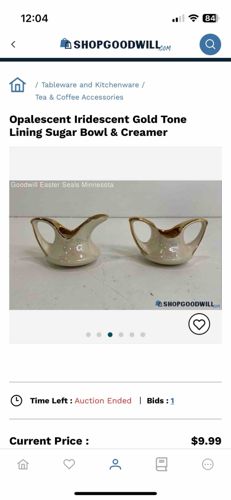
This exquisite set comprises two miniature ceramic vessels: an opalescent iridescent gold-tone lined sugar bowl and a matching creamer. Each piece measures precisely 2.25 inches tall and 3 inches wide, indicating a design intended for individual servings or decorative purposes due to their small scale. The main body of both items is crafted from fine porcelain or glazed ceramic, featuring a pristine off-white or cream-colored exterior with a smooth, glossy finish. Their most striking feature is the luxurious opalescent and iridescent gold-tone lining that generously coats the entire interior and rims. This unique finish captures and reflects light, creating a dynamic play of colors that shimmers primarily with gold, but also hints of subtle pinks, greens, and blues, much like mother-of-pearl. Both the sugar bowl and creamer share an elegant, integrated design with open, wing-like handles that flow seamlessly from the body. The creamer has a distinct pouring spout, while the sugar bowl maintains a symmetrical, open silhouette. Visually, the set appears to be in good vintage condition, showing no immediately discernible chips, cracks, or significant damage. The iridescent gold lining seems well-preserved, with no obvious flaking or heavy wear, though a minor patina might be present consistent with age. No visible manufacturer's marks, signatures, or stamps are discernible from the provided image. The aesthetic, characterized by its use of rich iridescence and compact, stylized forms, suggests a mid-20th-century origination, likely from the 1940s to 1960s. Their diminutive size makes them particularly unique, whether used for intimate tea services, as part of a collection, or as charming decorative elements. The uniform application of the glaze and iridescent finish points to a good level of craftsmanship in their production.
AI Appraisal Report
Upon examining the images and details provided for this Opalescent Iridescent Gold Tone Lined Sugar Bowl & Creamer, I am presented with a charming and unique set. Standing at 2.25 inches tall, their diminutive size suggests they are likely from a miniature tea set or intended for individual servings, possibly for a demitasse service. The most significant value-driving feature is the beautifully preserved opalescent iridescent gold-tone lusterware lining, which appears vibrant and largely intact. The streamlined, wing-like handles are characteristic of mid-20th-century design, likely dating the set to the 1940s-1960s. The set appears to be in very good vintage condition, with no visible chips or cracks. The primary challenge in valuation is the absence of a manufacturer's mark. Without a maker's mark (such as Lefton, Noritake, or a German porcelain house), the set must be valued as a decorative collectible rather than by a specific, highly sought-after producer. Market comparables for unmarked, mid-century lusterware creamer and sugar sets of this size and condition typically sell in the collector's market for modest sums. While their unique aesthetic and excellent condition are positives, the lack of branding significantly tempers the value. A full appraisal would require in-person examination to confirm the absence of marks, assess for any subtle crazing or wear not visible in photos, and verify the material quality.