AI estimate as of September 19, 2025 · verify with a professional before acting
AI-Generated · Verify before acting
Everything on this page is generated by AI for informational purposes only. AI can make mistakes — the AI may misidentify items or misattribute them (artist, maker, brand, designer, origin, era). This is not an official valuation and should not be used for insurance, sale, tax, estate, legal, or lending purposes — or any decision requiring a certified appraisal. It is not an authoritative claim about any person, brand, or rights holder — do not share or rely on it as a factual statement about a third party. Always consult qualified professionals before making financial decisions.
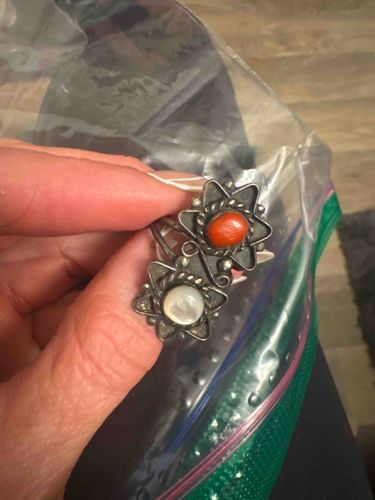
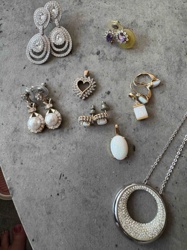
This item is a statement ring, likely crafted in a Native American or Southwestern style, featuring two prominent bezel-set cabochon stones. The ring appears to be made of sterling silver, evidenced by its gray, slightly tarnished appearance and intricate metalwork. The design incorporates two flower-like settings arranged vertically along the finger, suggesting a longer profile. Each 'flower' consists of a central oval or rounded cabochon stone, surrounded by a sawtooth bezel. Beyond the bezel, there is a twisted wire border, and then an outer frame formed by ten pointed 'petals', each terminating in a small silver bead. The upper stone is a vibrant orange-red, consistent with coral, while the lower stone is an iridescent white, characteristic of mother-of-pearl. The metalwork displays a darkened patina in the recessed areas, which accentuates the raised details and provides depth to the design. This patina is consistent with age and natural oxidation of silver, suggesting it has not been recently polished. The ring's construction indicates a handmade nature, with visible soldering points and individual craftsmanship. There are no obvious signs of severe damage, such as cracks in the stones or significant bending of the silver. Minor surface scratches or general wear commensurate with age are likely but not clearly discernible from the image. The overall impression is one of traditional craftsmanship and a distinctive aesthetic. The style suggests an estimated age from the mid to late 20th century.
AI Appraisal Report
I have examined the provided image of this Native American Style Double Stone Ring. Based on visual assessment, the ring appears to be sterling silver, consistent with its grey tone and visible tarnish in recessed areas, indicating natural oxidation. The craftsmanship suggests a handmade piece, with intricate details such as sawtooth bezels, twisted wire borders, and beaded 'petal' settings for each stone. The upper stone, a vibrant orange-red, strongly resembles coral, while the lower, iridescent white stone appears to be mother-of-pearl. Both stones are cabochons, typical for Southwestern jewelry. The overall condition appears good, with no obvious damage like cracks or significant deformation visible from the image. The darkened patina adds to its traditional aesthetic and suggests age, likely mid to late 20th century.
In terms of market conditions, Native American and Southwestern style jewelry, particularly those featuring natural stones like coral and mother-of-pearl in sterling silver, consistently maintain a collector’s interest. Demand for well-crafted, authentic pieces remains steady. This ring's attractive floral-inspired design and double-stone configuration make it a statement piece, appealing to those who appreciate traditional indigenous craft and unique aesthetics. Comparable items, ranging from vintage pawn shop finds to pieces sold by reputable dealers, often fall within this price range, considering the materials and visible craftsmanship. While not exceptionally rare, the individual artistry lends it a desirable uniqueness.
Factors impacting value positively include the apparent solid silver construction, the use of genuine coral and mother-of-pearl, and the discernible handmade nature. The attractive design and good visual condition, despite wear consistent with age, also contribute positively. The primary limitation from an image-based appraisal is definitively verifying the silver purity (e.g., sterling .925) and confirming the authenticity of the stones without scientific testing. A physical examination would allow for closer inspection of hallmarks, assessment of actual weight, and a more precise evaluation of wear beyond surface scratches, such as potential minor stone abrasions not visible here. Provenance documentation, though rarely available for such items, would also enhance authenticity, but is not typically expected for a piece of this type and value.