AI estimate as of November 18, 2025 · verify with a professional before acting
AI-Generated · Verify before acting
Everything on this page is generated by AI for informational purposes only. AI can make mistakes — the AI may misidentify items or misattribute them (artist, maker, brand, designer, origin, era). This is not an official valuation and should not be used for insurance, sale, tax, estate, legal, or lending purposes — or any decision requiring a certified appraisal. It is not an authoritative claim about any person, brand, or rights holder — do not share or rely on it as a factual statement about a third party. Always consult qualified professionals before making financial decisions.
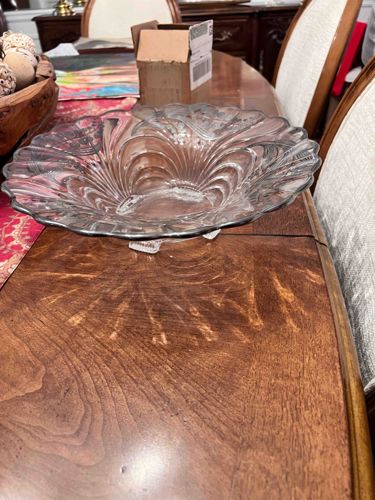
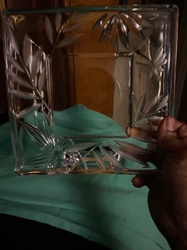
This item is a clear pressed glass bowl, distinguished by its circular, shallow form with an undulating, scalloped rim. The primary decorative feature is a prominent radiating fan or shell-like pattern that emanates from the center of the bowl, extending outwards towards the rim. The individual 'flutes' or segments of the fan pattern are well-defined and create a dynamic interplay of light and shadow within the glass. While the specific dimensions are not provided, the bowl appears to be a medium-to-large size, suitable for serving, display, or as a centerpiece. The material is clear, transparent glass, exhibiting a good level of clarity with no immediately visible significant inclusions or cloudiness. The construction suggests it is a product of pressed glass manufacturing, a common technique for creating intricately patterned glassware efficiently. There are no discernible maker's marks, signatures, or stamps visible in the provided image. The overall condition appears to be good, with no obvious chips, cracks, or significant abrasions visible from this viewing angle. Without further inspection, it's difficult to ascertain specific wear patterns like surface scratches or pitting, but the general impression is one of well-preserved glassware. This style of pressed glass with a radiating or fluted pattern was popular across various periods, particularly from the late 19th to mid-20th centuries, suggesting an estimated age within that broad range. The craftsmanship indicates a standard production quality typical of pressed glass items, designed for both aesthetic appeal and practical use.
AI Appraisal Report
I have visually assessed this clear pressed glass scalloped bowl with a radiating fan pattern. Based on the provided image, the bowl appears to be in good overall condition, with no immediate visible chips, cracks, or significant abrasions. Its clarity suggests well-preserved glass with no obvious cloudiness or significant inclusions. The design, characterized by its scalloped rim and prominent radiating fan pattern, is typical of pressed glass production, a technique widely used from the late 19th to mid-20th centuries. This manufacturing method allowed for efficient mass production of decorative yet functional glassware. Given the absence of maker's marks, which is common for many pressed glass pieces, definitive attribution to a specific manufacturer or period without further information is challenging. The market for general pressed glass bowls of this type is robust but also highly saturated. Demand remains steady for attractive, undamaged pieces, but rarity is low due to the high production volumes in their era. Comparable items frequently appear in antique shops, online marketplaces, and estate sales, typically priced modestly. Factors significantly impacting value include the lack of unique design elements, maker's marks, or historical provenance. Should it be identified as a pattern from a highly collectible manufacturer like Westmoreland or Duncan & Miller, or if it were an unusual color, the value would increase. However, as a standard clear piece, it fits into a broad category of decorative but not particularly rare glassware. My assessment of authenticity is based solely on visual characteristics consistent with pressed glass from the perceived era; however, definitive authentication without physical examination is impossible. An in-person inspection would be needed to verify the absence of minute surface wear, internal flaws, and to potentially identify an unphotographed mold mark. Provenance documentation, if available, would also aid in solidifying its history and potentially its value, but is unlikely for this type of item.