AI estimate as of July 10, 2025 · verify with a professional before acting
AI-Generated · Verify before acting
Everything on this page is generated by AI for informational purposes only. AI can make mistakes — the AI may misidentify items or misattribute them (artist, maker, brand, designer, origin, era). This is not an official valuation and should not be used for insurance, sale, tax, estate, legal, or lending purposes — or any decision requiring a certified appraisal. It is not an authoritative claim about any person, brand, or rights holder — do not share or rely on it as a factual statement about a third party. Always consult qualified professionals before making financial decisions.
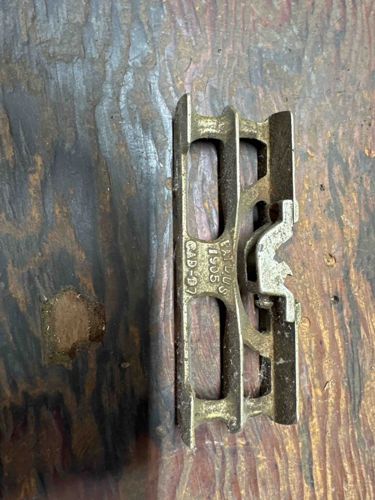
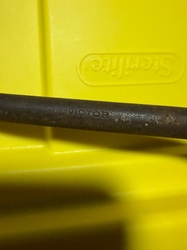
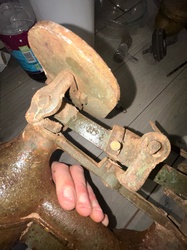
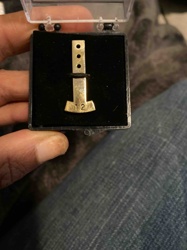
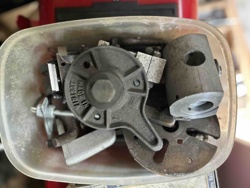
The item appears to be an antique metal component, likely cast iron or a similar heavy-duty alloy, characterized by its robust construction and utilitarian design. It is rectangular in shape, approximately 5-6 inches in length based on the perspective, composed of a series of interconnected bars forming a caged or slotted structure. The material shows a dark, aged patina consistent with ferrous metals exposed over time, exhibiting some surface discoloration and potential very light surface corrosion, indicating its age and prior use. Notable features include inscriptions cast directly into the metal; one visible marking reads "RATCLIFF 1905," strongly suggesting a manufacturing date or patent date of 1905 and potentially a maker's name. Another inscription, partially visible, appears to be "CAD-97". The item incorporates a small, hinged or pivoting mechanism on one side, which looks like a latch or a securing clip, demonstrating a functional purpose. The craftsmanship suggests a sturdy, industrial-era manufacturing process, likely casting, with visible mold lines or rough edges characteristic of such production methods. Despite its age, the component seems to be largely intact with no obvious major breaks or catastrophic damage, though the exact function without context is unclear. It bears the wear and tear expected of a vintage piece of hardware or a tool part, with signs of friction or repetitive motion on the moving part. Its solid construction and historical markings make it a compelling piece of industrial archeology.
AI Appraisal Report
Upon visual examination of the provided image, this Ratcliff 1905 cast metal component/latch presents as an authentic piece of early 20th-century industrial hardware. Its rectangular form, robust construction, and cast-in inscriptions, 'RATCLIFF 1905' and 'CAD-97,' strongly support its stated age and origin. The dark, aged patina and visible surface discoloration are consistent with ferrous metals exposed over time, indicating genuine age rather than artificial antiquing. The presence of a small, hinged mechanism suggests a functional purpose, likely as a latch or securing clip, characteristic of utilitarian components from that era. Craftsmanship, with its visible mold lines, aligns with common casting methods of the period.
Regarding condition, the piece appears largely intact with no obvious major breaks, though some light surface corrosion is visible, which is expected wear for an item of this age. Its full functionality cannot be definitively assessed without physical inspection. Market conditions for antique industrial hardware and tooling vary; while pieces from well-known manufacturers or with clear historical significance can command higher prices, generic hardware often has a more modest value. Demand for such specific, non-iconic pieces is niche, appealing primarily to collectors of industrial Americana, steampunk enthusiasts, or those seeking historically accurate restoration components.
Factors impacting value include its genuine age, identifiable manufacturer (Ratcliff), and the specific 1905 dating. Without context for its original application, its inherent value is primarily as a historical curiosity or decorative element. Should its original use be identified as part of a significant machine or structure, its value could increase.
Limitations in authenticity verification from images alone are significant. While the markings appear consistent, a physical examination would allow for tactile assessment of the material, a check for tool marks inconsistent with casting processes of the era, and a more thorough evaluation of corrosion and wear patterns. Provenance documentation, such as original schematics or sales records, would be invaluable for full authentication and understanding its specific function. Scientific testing, like spectroscopic analysis, could confirm material composition.