AI estimate as of July 29, 2025 · verify with a professional before acting
AI-Generated · Verify before acting
Everything on this page is generated by AI for informational purposes only. AI can make mistakes — the AI may misidentify items or misattribute them (artist, maker, brand, designer, origin, era). This is not an official valuation and should not be used for insurance, sale, tax, estate, legal, or lending purposes — or any decision requiring a certified appraisal. It is not an authoritative claim about any person, brand, or rights holder — do not share or rely on it as a factual statement about a third party. Always consult qualified professionals before making financial decisions.
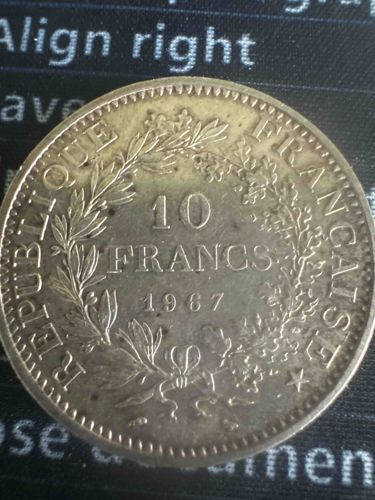
The item is a circular coin, likely made of a base metal alloy, given its silvery-gray appearance and the presence of some tarnishing or patination. The color suggests it could be an aluminum bronze, cupronickel, or similar alloy, as it lacks the bright luster typically associated with pure silver or the distinct color of bronze. The coin features a reeded edge, visible along the perimeter, indicating a pattern of small vertical grooves, a common security feature on coinage. The obverse (or reverse, depending on the standard orientation) of the coin clearly displays the denomination '10 FRANCS' centrally, with the year '1967' directly below it. Surrounding these inscriptions are two prominent laurel or olive branches, one on the left and one on the right, forming a semi-circular wreath. These branches are finely detailed, showing individual leaves and stems, and they are bound together at the bottom by a decorative ribbon or bow. Above the '10 FRANCS' inscription, the text 'REPUBLIQUE FRANCAISE' is inscribed along the upper circumference of the coin, indicating its origin as a French Republic coinage. The lettering appears to be in a sans-serif typeface, clean and legible, though some areas show signs of wear, particularly on the raised portions of the lettering and design elements, which exhibit a slight flattening and loss of sharpness. There are visible dark spots and surface discoloration, indicative of environmental exposure and age-related tarnishing, which is consistent with circulated coinage. No specific mint marks or designer's signatures are clearly discernible from the provided image, but the overall craftsmanship appears to be of standard monetary production quality for the stated period. The coin's overall condition suggests it has been in active circulation, showing moderate wear on its high points and an uneven patina, but no severe damage such as deep scratches, bends, or significant corrosion.
AI Appraisal Report
I have examined the provided image of this 1967 10 Francs French Coin. Based on its appearance, the coin is made of a base metal alloy, likely aluminum bronze or cupronickel, exhibiting typical tarnishing for such materials. The reeded edge is consistent with standard coinage. The design elements, '10 FRANCS,' '1967,' 'REPUBLIQUE FRANCAISE,' and the laurel/olive branches, appear authentic for this issue. Condition-wise, the coin shows moderate circulation wear, with some flattening on high points and noticeable environmental discoloration and spotting. This is consistent with a coin that has been in active circulation. While no severe damage (bends, deep scratches) is visible, the surface quality indicates an 'About Uncirculated' to 'Extremely Fine' grade, leaning towards EF due to the noticeable wear and uneven toning. These coins were minted in large quantities, with several million issued in 1967. Therefore, they are not rare. Market demand is generally modest for common circulated examples. The primary impact on value for this specific coin is its circulated condition and the lack of any unique variants or errors discernible from the image. Comparables for circulated 1967 10 Francs coins typically range in the single to low double digits USD. Without physical examination, I cannot definitively ascertain the exact metallic composition, precise weight, or confirm the absence of subtle mint errors or varieties. A more accurate grade would require in-hand inspection, allowing for evaluation under magnification and proper lighting. Authentication in terms of being a genuine 1967 French 10 Francs coin appears sound based on the visual evidence, but confirmation of specific mint marks or individual characteristics would require physical inspection. Provenance documentation, while helpful, is generally not maintained for common circulated coins of this type.