These notes were written by the person who submitted this item. Appraiser.AI has not verified them, and the AI's identification and estimate may rely on them.
AI Estimated Value
Not an official valuation
$4,000-6,000
AI estimate as of September 9, 2025 · verify with a professional before acting
AI-Generated · Verify before acting
Everything on this page is generated by AI for informational purposes only. AI can make mistakes — the AI may misidentify items or misattribute them (artist, maker, brand, designer, origin, era). This is not an official valuation and should not be used for insurance, sale, tax, estate, legal, or lending purposes — or any decision requiring a certified appraisal. It is not an authoritative claim about any person, brand, or rights holder — do not share or rely on it as a factual statement about a third party. Always consult qualified professionals before making financial decisions.
This analysis also relies on unverified notes provided by the user, which may be incomplete or inaccurate and could affect the result.
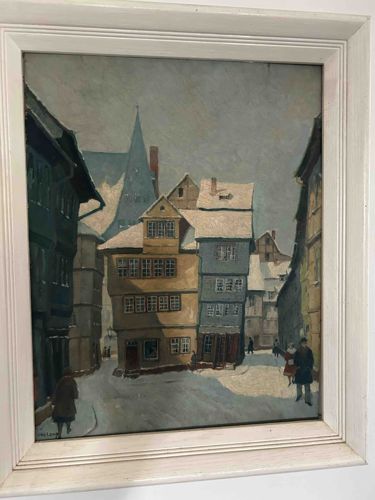
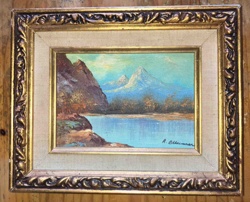
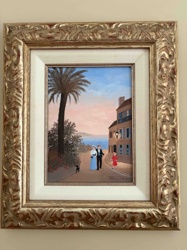
This item is an original oil painting by Otto Lange, depicting a winter street scene. The artwork is housed within a simple, white-painted wooden frame, which shows some signs of wear and age, including minor scuffs and possible discoloration, consistent with its likely period. The painting itself is rendered in a somewhat muted color palette, dominated by grays, blues, and browns, with touches of off-white to represent snow. The composition features a snowy street flanked by multi-story European-style buildings, many of which appear to be constructed with exposed timber framing and stucco infill, characteristic of older German architecture. Snow covers the rooftops and the ground, suggesting a cold, overcast day. In the background, the steeple of a large church or cathedral is visible, its spire reaching towards the sky, covered in snow. Several small, darkly clad figures populate the street, adding a sense of scale and human presence to the urban landscape. The brushwork appears somewhat loose and expressive, indicating a possible leaning towards Expressionism or a similar early 20th-century style. The overall condition of the painting appears good, with no obvious major damage like tears or significant paint loss visible from the provided image, though without closer inspection, details like craquelure or minor abrasions cannot be fully assessed. The artist's signature, "O LANGE" or "Otto Lange" is faintly visible in the lower left corner of the painting, confirming the attribution. Given the artist and stylistic elements, the painting likely dates from the early to mid-20th century.
AI Appraisal Report
Based on my visual examination of the provided image, this Winter Street Scene painting is attributed to Otto Lange. The artist's signature, "O LANGE" or "Otto Lange" is faintly visible in the lower left, which is a strong indicator of authenticity. Stylistically, the loose, expressive brushwork and muted palette are consistent with Lange's oeuvre, particularly his leanings towards Expressionism during the early to mid-20th century. The depiction of European architecture, likely German, further aligns with his known subjects. The painting appears to be in good overall condition, showing no obvious major damage such as tears or significant paint loss. The frame, while showing wear, is simple and appropriate for the period, not detracting significantly from the artwork itself.
Market conditions for works by Otto Lange typically show steady demand, especially for his paintings and woodcuts. While not among the most widely recognized Expressionists, his works are valued for their artistic merit and historical significance. Comparable sales of Lange's paintings, particularly those depicting urban or landscape scenes, suggest a value range. The presence of figures and architectural detail enhances its appeal. Rarity is a factor, as paintings by Lange are less common than his prints.
Factors impacting value positively include the apparent good condition, the clear signature, and the characteristic style. The primary limitation in this appraisal is the reliance on images alone. For full authentication, an in-person examination would be crucial to assess paint surface, craquelure, and potential restorations. Provenance documentation, detailing the artwork's ownership history, would significantly enhance authenticity and value. Scientific testing, such as pigment analysis, could further confirm its age and materials.