AI estimate as of July 28, 2025 · verify with a professional before acting
AI-Generated · Verify before acting
Everything on this page is generated by AI for informational purposes only. AI can make mistakes — the AI may misidentify items or misattribute them (artist, maker, brand, designer, origin, era). This is not an official valuation and should not be used for insurance, sale, tax, estate, legal, or lending purposes — or any decision requiring a certified appraisal. It is not an authoritative claim about any person, brand, or rights holder — do not share or rely on it as a factual statement about a third party. Always consult qualified professionals before making financial decisions.
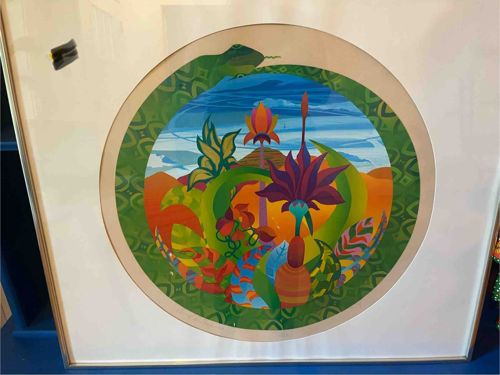
This is a framed circular print or painting, characterized by vibrant, saturated colors and a whimsical, possibly surrealistic or folk art style. The central circular image depicts a vibrant landscape featuring a prominent green serpent forming a full circle (Ouroboros-like) at the top, biting its own tail, symbolizing eternity or cyclical renewal. Within this circular frame, there is a vivid landscape with large, stylized flora in various rich hues including purple, orange, red, and blue. A conical structure, possibly a pyramid or volcano, is visible in the middle ground, and a blue sky with light clouds forms the background. The foreground features abstract plant life and possibly a jar or vase-like structure. The color palette is very bright and diverse, creating a lively and energetic scene. The circular image is surrounded by a green border with a repeating pattern, which is then set within a larger, off-white mat board. The entire piece is enclosed in a slender, metallic frame, likely aluminum or a similarly finished material. The mat board appears clean and well-maintained. The image itself shows no obvious signs of significant damage like tears, creases, or major discoloration, maintaining its original vibrancy. There is some visible glare on the protective glazing, suggesting it is under glass or acrylic. The overall construction appears professional, indicative of a decorative piece of art, possibly a screen print, lithograph, or a giclée print. The style suggests a 20th-century origin, perhaps mid to late 20th century, given the intensity of the colors and stylized representation, reminiscent of psychedelic art or illustrative works from that period. The clarity of the image and lack of visible brushstrokes suggest it is more likely a print than an original painting.
AI Appraisal Report
Upon my virtual examination of this 'Ouroboros Serpent' Circular Landscape Print, I observe a well-preserved decorative art piece. The condition appears excellent; the colors are vibrant and well-saturated, and there are no discernible tears, creases, or major discoloration visible through the protective glazing. The mat board is clean, and the frame presents a professional finish. Authenticity is challenging to ascertain definitively from images alone; without tactile inspection, it is difficult to determine if this is a high-quality print (e.g., giclée, lithograph, or screen print) or an original work. The lack of visible brushstrokes strongly suggests it is a print.
In terms of market conditions, this piece likely appeals to collectors of whimsical, surreal, or folk art styles, particularly those interested in themes of nature, mythology, and cyclical renewal. Comparable decorative prints of similar size and artistic merit from the mid-to-late 20th century typically fetch modest prices unless attributed to a renowned artist or possessing significant historical provenance. Demand for such pieces is generally stable within niche markets, but they are not considered rare.
Factors significantly impacting value include the potential for this to be a limited-edition print by a known, albeit not necessarily famous, artist. If it were proven to be a unique painting, the value would be significantly higher.
Limitations in authenticity verification are paramount here. An in-person examination would be crucial to determine the exact printing technique or if it is an original painting. I would need to inspect the paper quality, printing dots (if a print), and look for any artist's signature or edition number. Provenance documentation, such as receipts or exhibition histories, would be vital for full authentication and attribution. Scientific testing, like pigment analysis, would be necessary if the artwork were purported to be an original painting by a specific artist, but based on visual cues, this is unlikely.