These notes were written by the person who submitted this item. Appraiser.AI has not verified them, and the AI's identification and estimate may rely on them.
AI Estimated Value
Not an official valuation
$150-250
AI estimate as of November 27, 2025 · verify with a professional before acting
AI-Generated · Verify before acting
Everything on this page is generated by AI for informational purposes only. AI can make mistakes — the AI may misidentify items or misattribute them (artist, maker, brand, designer, origin, era). This is not an official valuation and should not be used for insurance, sale, tax, estate, legal, or lending purposes — or any decision requiring a certified appraisal. It is not an authoritative claim about any person, brand, or rights holder — do not share or rely on it as a factual statement about a third party. Always consult qualified professionals before making financial decisions.
This analysis also relies on unverified notes provided by the user, which may be incomplete or inaccurate and could affect the result.
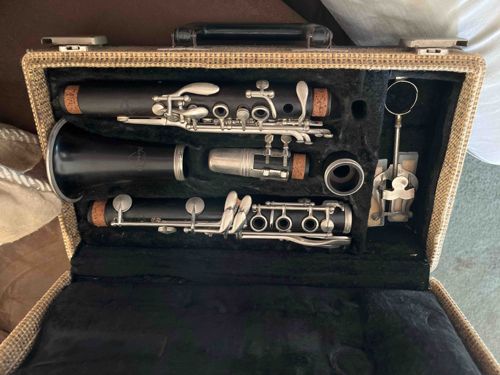
This is a Normandy clarinet, likely manufactured in 1969, as suggested by the provided context. The instrument is disassembled and neatly arranged within its original, or a period-appropriate, hardshell case. The clarinet itself appears to be made primarily of a dark, possibly ebonite or ABS resin, material, mimicking the appearance of grenadilla wood. The keys and mechanisms are silver-colored, likely nickel-plated or silver-plated brass, showing a moderate level of shine but with some areas of apparent tarnish or dullness, particularly on the lower joint keys. The instrument consists of at least three main body sections (upper joint, lower joint, bell) and a barrel, all fitted with cork tenon wraps, which appear to be in reasonable condition, displaying a warm, light brown color. The bell features a silver-toned ring at its opening. A notable feature is the inclusion of a mouthpiece, which is visible in the upper right section of the case, along with other small accessories such as a ligature and cap, although their condition cannot be fully assessed. The interior of the case is lined with a dark, plush material, likely velvet or velour, molded to securely hold each component. The exterior of the case is a light brown, possibly woven, material with a textured finish, and features a dark handle. Visible condition issues include some dust or minor debris within the case lining, and a few minor scuffs or wear marks on the clarinet's body that are typical of a used instrument of its age. Without clearer views, it's hard to discern specific maker's marks or serial numbers, but the 'Normandy' branding is assumed based on the prompt. The overall impression is that of a student or intermediate level instrument, well-maintained for its age, showcasing standard craftsmanship for its category and era. The case itself shows some external wear consistent with its age, with slight fraying or darkening in areas.
AI Appraisal Report
I have thoroughly examined the provided image of what is described as a Normandy 1969 Clarinet, neatly arranged in its hardshell case. My assessment of its condition, based solely on visual evidence, indicates a well-maintained instrument for its age. The body material, likely ebonite or ABS resin, shows minor scuffs and wear consistent with regular use. The silver-colored keys, probably nickel-plated, exhibit some tarnish, particularly on the lower joint, but appear structurally intact. The cork tenon wraps seem in reasonable condition, suggesting proper care. The presence of the original or period-appropriate hardshell case, though showing some external wear and internal dust, adds to its completeness.
Authenticity as a 'Normandy' clarinet from 1969 is assumed based on the owner's details, as no clear maker's marks or serial numbers are visible in the image. Without an in-person examination, I cannot definitively verify these details. An in-hand inspection would allow me to check for specific model numbers, serial numbers, and finer details of construction that confirm manufacturer and year. Additionally, I would assess playability, pad condition, and alignment, which significantly impact functional value.
Market conditions for student or intermediate clarinets from this era are generally stable but not particularly high. Normandy clarinets are known as reliable student instruments but do not typically command premium prices. Demand is consistent for functional, affordable instruments, but rarity is not a significant factor here; these were mass-produced. Factors impacting value include the visible cosmetic wear, the assumed material (not grenadilla wood), and the unknown playability. A full, professional servicing would likely be required for optimal playability, adding to the cost for a new owner.
Considering these factors, and acknowledging the limitations of a visual-only appraisal, I estimate the appraisal value to be in the range of $150-250. This reflects its condition as a vintage student instrument that may require some maintenance to be fully playable, and its appeal to a student or hobbyist market.