AI estimate as of September 26, 2025 · verify with a professional before acting
AI-Generated · Verify before acting
Everything on this page is generated by AI for informational purposes only. AI can make mistakes — the AI may misidentify items or misattribute them (artist, maker, brand, designer, origin, era). This is not an official valuation and should not be used for insurance, sale, tax, estate, legal, or lending purposes — or any decision requiring a certified appraisal. It is not an authoritative claim about any person, brand, or rights holder — do not share or rely on it as a factual statement about a third party. Always consult qualified professionals before making financial decisions.
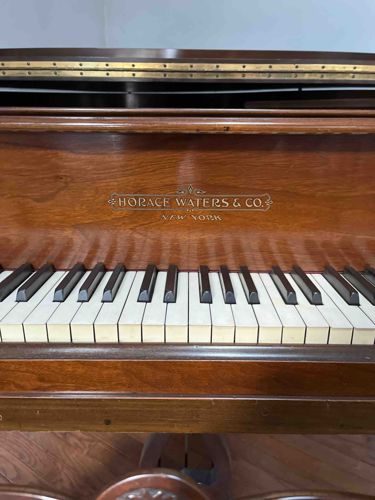
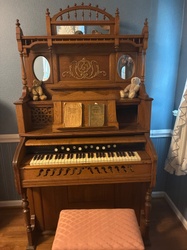
This item is an antique upright piano, manufactured by 'Horace Waters & Co.' of 'NEW YORK', as indicated by the prominent inscription embossed or stenciled in a decorative gold-colored font on the fallboard. The piano's casing appears to be constructed from a rich, warm-toned wood, likely oak or mahogany, exhibiting a noticeable grain pattern that suggests solid wood construction rather than veneer, particularly on the fallboard. The finish shows a moderate sheen, consistent with aged furniture, and some minor surface wear is visible, including what appears to be a small chip or abrasion on the fallboard directly above the right side of the 'HORACE WATERS' inscription. The keyboard consists of white keys, which have yellowed slightly with age, a common characteristic of ivory or celluloid key tops over time, and black keys that retain their dark finish. The ivory keys show some subtle variations in color, further suggesting their age and material. A brass or gold-toned metal strip with small decorative indentations runs along the upper edge of the case, just below the music rack area, adding a touch of embellishment. The overall style suggests an early 20th-century or late 19th-century manufacturing period, consistent with the historical operations of Horace Waters & Co. The visible craftsmanship, particularly in the detailed manufacturer's mark and the solid wood appearance, indicates a quality instrument from its era. The piano's condition appears relatively good for its age, though specific functional details are not discernible from the image.
AI Appraisal Report
I have examined the provided image of this Horace Waters & Co. Upright Piano. Based on my visual assessment, the piano appears to be an authentic instrument from the late 19th or early 20th century, consistent with the documented operational period of Horace Waters & Co. The brand inscription on the fallboard is clear and indicative of authenticity. Its construction, featuring what appears to be solid, warm-toned wood (likely oak or mahogany) with a visible grain, suggests a quality instrument from its era. The yellowing of the white keys is typical for ivory or celluloid key tops of that age, further supporting its vintage. The brass or gold-toned metal strip is a nice embellishment characteristic of the period.
The condition appears relatively good for its age, with a moderate sheen to the finish. Minor surface wear, including a small chip or abrasion on the fallboard, is visible but does not significantly detract from its aesthetic appeal for a vintage piece.
Market conditions for antique upright pianos are generally soft. While this appears to be a quality instrument, its value is primarily decorative unless fully restored to playable condition. Comparables for similar vintage upright pianos in unrestored or partially restored condition typically range from a few hundred to just over a thousand dollars, depending heavily on the brand's prestige, condition, and playability. Horace Waters & Co. was a respectable but not top-tier manufacturer, which impacts rarity and demand. Factors significantly impacting value include the current playability, the structural integrity of the soundboard and pin block (which cannot be determined from an image), and the cost of any necessary repairs or restoration.
It is important to note that this appraisal is based solely on visual examination of the provided image. Full authentication and a definitive assessment of value would require an in-person inspection by a qualified piano technician to evaluate the internal components (soundboard, pin block, strings, hammers, action), verify the key material, and confirm structural integrity. Without this, I cannot speak to its musical functionality or the full extent of its restorability.