AI Appraisal Estimate

AI-generated estimates · not official valuations

From the user

What was submitted

Photo and notes provided by the user — not generated by AI

Submitted item photo
Submitted photo · June 10, 2026

User's notes

Oil on canvas

AI analysis below

AI appraisal

AI analysis & estimate

AI-Generated · Verify before acting

Everything below is generated by AI for informational purposes only. AI can make mistakes — the AI may misidentify items or misattribute them (artist, maker, brand, designer, origin, era). This is not an official valuation and should not be used for insurance, sale, tax, estate, legal, or lending purposes — or any decision requiring a certified appraisal. It is not an authoritative claim about any person, brand, or rights holder — do not share or rely on it as a factual statement about a third party. Always consult qualified professionals before making financial decisions.

Note

This analysis also relies on unverified notes provided by the user, which may be incomplete or inaccurate and could affect the result.

Read the full disclaimer

AI Identification

·Not independently authenticated·Verify before acting

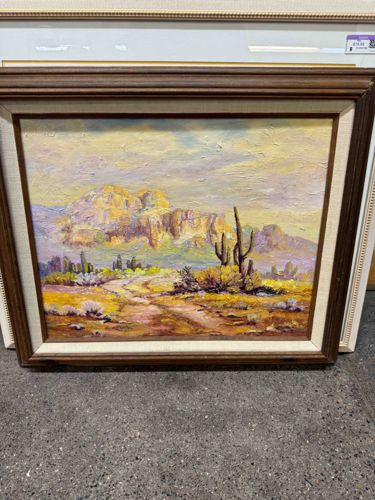
Impressionist Southwestern Desert Landscape Oil Painting

Fine Art - Paintings

AI Estimated Value

·Not an official valuation·Verify before acting

$1,200 - $1,800

As of June 10, 2026

AI Item Analysis

·AI can make mistakes·Verify before acting
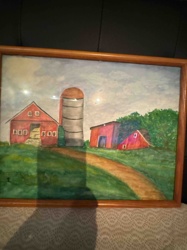
This original oil on canvas artwork depicts a sweeping Southwestern desert vista, possibly representing the Superstition Mountains or a similar Arizona landscape. The painting is executed in an impressionistic style with heavy, impasto brushwork that creates a rich, tactile surface texture. The color palette is dominated by warm ochres, golden yellows, and earthy browns in the foreground, transitioning into soft purples, lavenders, and pale blues in the atmospheric mountains and sky. A prominent Saguaro cactus serves as a focal point in the middle ground, standing alongside desert scrub and a winding dirt path that leads the viewer's eye into the composition. The artwork is housed in a period-appropriate multi-layered frame consisting of a dark stained wood outer molding, a neutral linen-covered liner, and a thin gold-toned inner fillet. The style and framing suggest a mid-to-late 20th-century origin, likely circa 1960s-1980s. The condition appears stable with no immediate signs of flaking or significant craquelure, although the linen liner shows minor age-related discoloration. The craftsmanship reflects a confident hand with a strong grasp of light and atmospheric perspective typical of regional American plein air or studio artists of the period.


AI Appraisal Report

·AI can make mistakes·Verify before acting
I have virtually examined this impressionistic oil on canvas depicting a Southwestern desert landscape. The work exhibits high technical proficiency, particularly in the impasto application and the atmospheric perspective used to render the mountain range. The use of a Saguaro as a central vertical anchor is a classic trope of Arizona regionalism, likely dating from the 1960s to 1980s. The condition appears structurally sound; the impasto is stable without visible cleavage, though the linen liner shows expected oxidation. The frame is a quintessential 'gallery-style' of the era, adding to its decorative appeal. Market demand for Southwestern Impressionism remains steady, driven by regional collectors in the American West. Comparables for mid-century regional landscapes of this scale and quality typically reach the low-to-mid four-figure range at specialized auctions. The lack of a visible signature in the provided description slightly tempers the valuation; if linked to a known 'Desert Pro' artist like John Hilton or a contemporary, the value would increase significantly. Conversely, as an unsigned piece of high decorative quality, it holds strong value as a 'School of' work. Limitations: This appraisal is based on digital images and cannot confirm the presence of overpainting or canvas brittleness. A physical inspection under UV light is required to check for hidden signatures or restorations. Furthermore, I cannot definitively verify the age of the pigments or the canvas substrate without a tactile examination of the tacking edges and stretcher bars. To achieve a full certificate of authenticity, provenance documentation—such as an original gallery bill of sale—would be necessary.

Get your items appraised

Instant estimates of your treasures with AI-powered appraisals

Browse More Appraisals