These notes were written by the person who submitted this item. Appraiser.AI has not verified them, and the AI's identification and estimate may rely on them.
AI Estimated Value
Not an official valuation
$200 - $350
AI estimate as of September 21, 2025 · verify with a professional before acting
AI-Generated · Verify before acting
Everything on this page is generated by AI for informational purposes only. AI can make mistakes — the AI may misidentify items or misattribute them (artist, maker, brand, designer, origin, era). This is not an official valuation and should not be used for insurance, sale, tax, estate, legal, or lending purposes — or any decision requiring a certified appraisal. It is not an authoritative claim about any person, brand, or rights holder — do not share or rely on it as a factual statement about a third party. Always consult qualified professionals before making financial decisions.
This analysis also relies on unverified notes provided by the user, which may be incomplete or inaccurate and could affect the result.
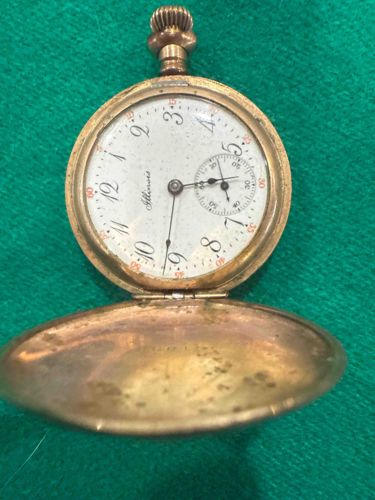
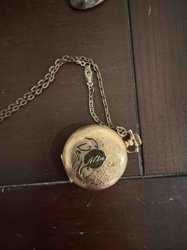
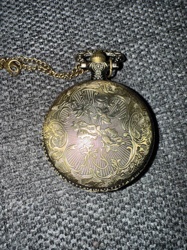
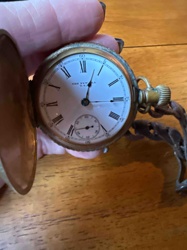
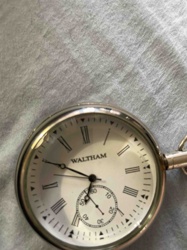
This item is an antique or vintage open-face pocket watch, appearing to be gold-toned, possibly gold-plated or gold-filled, rather than solid gold, given the visible wear and discoloration. The watch features a white or off-white dial with black Arabic numerals for the hours. There are also smaller, possibly red, numeric markers for minutes, indicating a railway dial style or similar clear legibility design. The dial prominently displays the manufacturer's name 'Illinois' vertically oriented. It has a sub-dial for seconds located between the 4 and 5 o'clock positions, a common feature in historical pocket watches. The main hour and minute hands appear to be a dark, possibly blued steel, while the seconds hand on the sub-dial is also dark. The crystal covering the dial is possibly acrylic or glass, showing some dust and minor surface imperfections. The watch case itself is circular with a hinged cover visible in the foreground, which shows significant wear, tarnishing, and discoloration, suggesting age and use. The case exhibits areas where the finish has worn through, revealing a different base metal or a corroded surface. The crown, located at the 12 o'clock position (opposite the visible hinge), is fluted and also appears gold-toned with some patination. The overall condition suggests a well-used item, with moderate to significant visible wear, tarnishing, and potential surface damage to the case and cover. The craftsmanship appears consistent with early 20th-century American watchmaking, known for its precision and durability, though specific details like movement grade are not discernible from the image. The watch likely dates from the late 19th to mid-20th century.
AI Appraisal Report
Upon examining this Illinois open-face pocket watch, I have determined a fair market value based on its visible characteristics. The dial, featuring black Arabic numerals and a seconds sub-dial between 4 and 5 o'clock, is consistent with early 20th-century Illinois Watch Company designs. The case is gold-toned, likely gold-filled or plated, as indicated by the significant wear, discoloration, and areas where the finish has worn through to the base metal. This level of wear categorizes the watch in fair to moderate cosmetic condition. The primary factor driving the value of Illinois pocket watches is the movement's grade, jewel count, and operational status, none of which can be determined from an image alone. Market comparables for similar Illinois gold-filled watches in non-working or unknown working condition typically sell in the $150 to $250 range. If the movement is a higher grade (e.g., a Bunn Special) and is fully functional, the value could increase. However, the visible cosmetic wear on the case significantly limits its appeal to serious collectors, who prefer pristine examples. The current value reflects its potential as a parts watch or a restoration project. For a comprehensive appraisal, an in-person examination is essential to open the case, identify the movement's serial number and grade, and assess its mechanical condition. Without this physical inspection and confirmation of its operational status, I cannot provide a more definitive valuation.