AI estimate as of September 27, 2025 · verify with a professional before acting
AI-Generated · Verify before acting
Everything on this page is generated by AI for informational purposes only. AI can make mistakes — the AI may misidentify items or misattribute them (artist, maker, brand, designer, origin, era). This is not an official valuation and should not be used for insurance, sale, tax, estate, legal, or lending purposes — or any decision requiring a certified appraisal. It is not an authoritative claim about any person, brand, or rights holder — do not share or rely on it as a factual statement about a third party. Always consult qualified professionals before making financial decisions.
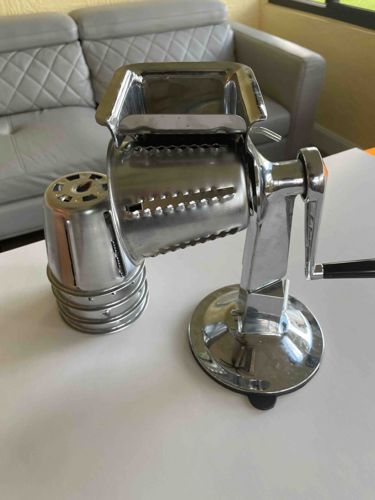
This is a vintage-style rotary grater, likely used for cheese, nuts, or vegetables. It is constructed primarily of polished chrome-plated metal, exhibiting a bright, reflective silver color. The main body consists of a cylindrical grater drum, visible through an opening in the housing, and a Hopper at the top for inserting food items. The grating drum appears to have small, raised, serrated edges designed for shredding. Adjacent to the grater housing is a crank assembly with a black ergonomic handle, suggesting manual operation. The grater is mounted on a sturdy stand that terminates in a round, polished base. This base incorporates a black rubber or plastic suction cup mechanism, visible underneath the chrome plate, designed to secure the grater firmly to a countertop during use. The overall construction appears robust, indicative of kitchenware from the mid-20th century. There are no obvious dents or major damage, but some minor surface scratches and faint scuff marks are visible on the chrome finish, consistent with light to moderate use and age. The chrome plating appears largely intact with a good sheen, suggesting decent preservation for its age. There are no discernible maker's marks or signatures visible in the provided image. The design prioritizes functionality and durability, typical of kitchen tools from an era when appliances were built to last. The craftsmanship appears to be of standard industrial quality for such an item, with neatly formed and joined metal components.
AI Appraisal Report
Having visually examined this vintage-style rotary grater with a suction base, I can confirm its apparent construction from polished chrome-plated metal, consistent with kitchenware from the mid-20th century. The item presents in good vintage condition; while minor surface scratches and faint scuff marks are visible on the chrome, these are expected with age and light to moderate use. The chrome plating maintains a good sheen, indicating decent preservation. Authenticity, based solely on visual inspection, appears consistent with period kitchen tools of this type, prioritizing robust functionality. However, without a physical examination, I cannot definitively confirm the alloy composition or verify if the chrome plating is original or a later re-plating.
Market conditions for vintage kitchen utensils like this are generally stable, driven by collectors of retro kitchenalia and individuals seeking durable, functional alternatives to modern plastic devices. Demand is moderate, rather than high, and the item's rarity is low to moderate; while well-made, these graters were mass-produced. Factors impacting value include its good aesthetic condition, apparent complete functionality (assuming the crank turns freely and the suction base still grips), and the inherent durability of its construction. The lack of discernible maker's marks limits specific brand attribution, which could slightly enhance value if it were a recognized high-quality manufacturer like an early Mouli or Rival.
To fully authenticate and provide a more precise valuation, an in-person examination would be crucial. I would need to test the functionality of the crank mechanism and the suction base, analyze the specific type of metal used, and carefully search for any hidden maker's marks or patent numbers. Provenance documentation, such as original packaging or sales receipts, would further aid in age and brand verification, though such documentation is rare for common kitchen tools. Scientific testing, like X-ray fluorescence (XRF) analysis, could confirm metal composition and plating integrity, but this is typically reserved for higher-value items.