AI Appraisal Estimate

AI-generated estimates · not official valuations

From the user

What was submitted

Photo and notes provided by the user — not generated by AI

Submitted item photo
Submitted photo · June 25, 2026

User's notes

Unknown Artist, Untitled original artwork

AI analysis below

AI appraisal

AI analysis & estimate

AI-Generated · Verify before acting

Everything below is generated by AI for informational purposes only. AI can make mistakes — the AI may misidentify items or misattribute them (artist, maker, brand, designer, origin, era). This is not an official valuation and should not be used for insurance, sale, tax, estate, legal, or lending purposes — or any decision requiring a certified appraisal. It is not an authoritative claim about any person, brand, or rights holder — do not share or rely on it as a factual statement about a third party. Always consult qualified professionals before making financial decisions.

Note

This analysis also relies on unverified notes provided by the user, which may be incomplete or inaccurate and could affect the result.

Read the full disclaimer

AI Identification

·Not independently authenticated·Verify before acting

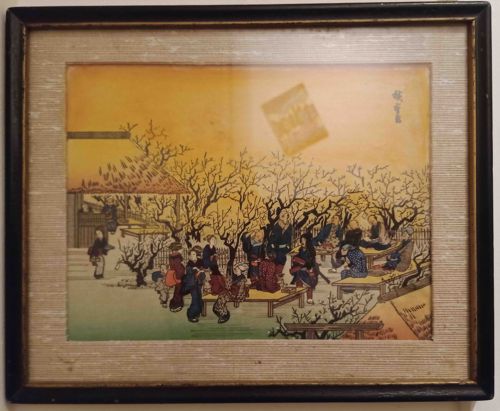
Japanese Ukiyo-e Style Woodblock Print of Plum Garden Scene

Fine Art Prints

AI Estimated Value

·Not an official valuation·Verify before acting

$100 - $200

As of June 25, 2026

AI Item Analysis

·AI can make mistakes·Verify before acting
This item is an original Japanese woodblock print, possibly an ukiyo-e work attributed to the school of Hiroshige, depicting a social gathering in a blossoming plum garden. The composition features numerous figures dressed in traditional Edo-period attire, including kimonos and hakama, seated at low tables or strolling beneath gnarled, budding trees. The color palette utilizes a characteristic ukiyo-e 'bokashi' (gradation) technique, notably in the transition from a warm golden-yellow sky to a green foreground. A prominent calligraphic signature and artist seal are visible in the upper right-hand corner. The print is housed in a dark wood frame with a textured silk or linen fabric mat. The artwork shows significant signs of age and condition issues: there is pronounced foxing (brown spots) across the matting and the image itself, significant yellowing/toning of the paper base, and a rectangular area of discoloration in the upper center, possibly from an old sticker or moisture damage. The style indicates a 19th-century origin, though it may be a later Meiji-era reprint. The fine linework in the tree branches and fabric patterns reflects high-quality carving and printing craftsmanship typical of classical Japanese printmaking.

AI Appraisal Report

·AI can make mistakes·Verify before acting
I have examined the digital images of this Japanese woodblock print, which depicts a lively scene of figures beneath blossoming plum trees, reminiscent of the Utagawa Hiroshige school's evocative landscapes. Based on the stylistic execution, particularly the bokashi (color gradation) in the sky and the intricate depiction of the gnarled tree bark, this piece appears to be a 19th-century Edo period original or a high-quality Meiji-era reprint. The composition is charming, yet the condition issues present a significant barrier to higher valuation. The print suffers from severe environmental damage. There is extensive foxing (fungal growth/oxidation spots) visible not only on the silk matting but infiltrating the print surface itself. The paper shows heavy toning (acidic yellowing) and a distinct rectangular discoloration in the upper center, likely from adhesive residue or water damage, which distracts from the artwork's integrity. While the carving lines remain sharp, these condition factors drastically reduce its marketability to serious collectors who seek pristine states. Attributing this to a specific master is difficult without physically inspecting the artist's seal and signature in the upper right, which are currently untranslated. If this were a verified first-state printing by Hiroshige I, the value would be significantly higher despite the damage. However, given the likelihood of it being a later edition and the current poor state of preservation, the value is primarily decorative rather than investment-grade. A physical inspection would be required to verify the paper texture (washi) and to decipher the seal for definitive attribution.

Get your items appraised

Instant estimates of your treasures with AI-powered appraisals

Browse More Appraisals