These notes were written by the person who submitted this item. Appraiser.AI has not verified them, and the AI's identification and estimate may rely on them.
AI Estimated Value
Not an official valuation
$150-250
AI estimate as of October 13, 2025 · verify with a professional before acting
AI-Generated · Verify before acting
Everything on this page is generated by AI for informational purposes only. AI can make mistakes — the AI may misidentify items or misattribute them (artist, maker, brand, designer, origin, era). This is not an official valuation and should not be used for insurance, sale, tax, estate, legal, or lending purposes — or any decision requiring a certified appraisal. It is not an authoritative claim about any person, brand, or rights holder — do not share or rely on it as a factual statement about a third party. Always consult qualified professionals before making financial decisions.
This analysis also relies on unverified notes provided by the user, which may be incomplete or inaccurate and could affect the result.
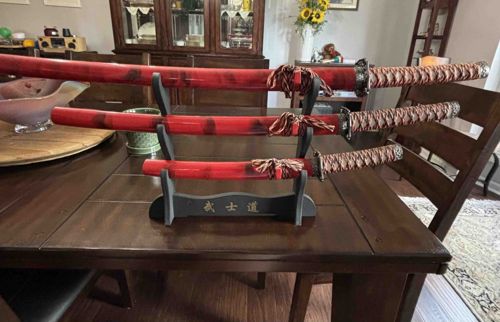
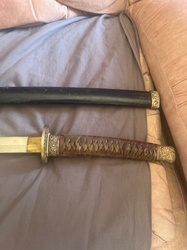
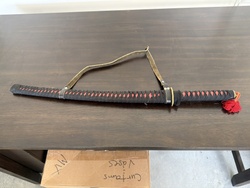
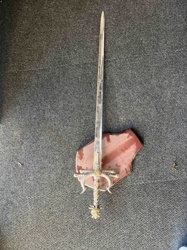
This is a decorative set of three Japanese-style swords, commonly referred to as a Daisho set, displayed on a tiered stand. The swords appear to be a long 'daikatana' or 'nodachi', a standard 'katana', and a shorter 'wakizashi', corresponding to traditional samurai armaments. Each sword features a glossy, vibrant red saya (scabbard) with irregular black or dark brown markings, giving them a distressed or artistic, almost blood-splattered, aesthetic. The tsuka (handle) of each sword is wrapped in a reddish-brown or dark sienna-colored cord, intricately braided. The tsuba (handguard) and other metal fittings, such as the fuchi (collar) and kashira (pommel), exhibit a dark, possibly antique-finished, metallic appearance with visible decorative motifs which are not clearly discernible in detail from the image. Each sword also has a decorative sageo (cord) tied around the saya, featuring similar reddish-brown hues. The blades themselves are sheathed and not visible. The three-tiered wooden display stand is black, featuring an embossed or carved gold-colored character inscription on the front of the lowest tier, which translates to 'Bushido' (武士道), the Samurai's code. The overall condition appears good, consistent with decorative display pieces, with no visible significant wear or damage to the saya or tsuka. These items are likely modern reproductions intended for ornamental purposes, rather than functional, historically accurate swords. The quality of craftsmanship for decorative pieces appears reasonable, with attention paid to color harmonization and traditional form.
AI Appraisal Report
I have examined the provided image of this decorative Samurai Sword Set, encompassing a Daikatana, Katana, and Wakizashi on a tiered display stand. Based on visual inspection, the set appears to be in good decorative condition. The vibrant red saya with black markings and the reddish-brown tsuka wrapping are visually consistent across all three pieces, suggesting they were produced as a matching set. The black display stand with the 'Bushido' inscription complements the swords effectively. Authenticity, in terms of identifying these as genuine antique or traditionally forged Japanese swords, is limited by visual examination alone. These are almost certainly modern decorative reproductions intended for display, not functional weapons, a common item in the collectible market. The visible details of the tsuba and other fittings, while present, lack the intricate detail typically found in even mid-range functional reproductions, let alone genuine artifacts. The glossy finish on the saya further points to a modern, mass-produced decorative aesthetic. Demand for such decorative sets is consistent, primarily driven by individuals seeking ornamental pieces for home or office decor, or enthusiasts of samurai culture looking for display items. They are neither rare nor particularly sought-after by serious collectors of historical weaponry. Factors impacting value are primarily their aesthetic condition and completeness as a set. Without physical inspection, I cannot confirm the material quality of the blades (though they are almost certainly stainless steel), the integrity of the handle wraps, or the true craftsmanship of the fittings. To definitively verify authenticity as historical artifacts, a physical examination by a specialist in Japanese blades, metallurgical testing, and comprehensive provenance documentation would be essential. Lacking these, my appraisal reflects the market for decorative, mass-produced sword sets.