AI estimate as of November 16, 2025 · verify with a professional before acting
AI-Generated · Verify before acting
Everything on this page is generated by AI for informational purposes only. AI can make mistakes — the AI may misidentify items or misattribute them (artist, maker, brand, designer, origin, era). This is not an official valuation and should not be used for insurance, sale, tax, estate, legal, or lending purposes — or any decision requiring a certified appraisal. It is not an authoritative claim about any person, brand, or rights holder — do not share or rely on it as a factual statement about a third party. Always consult qualified professionals before making financial decisions.
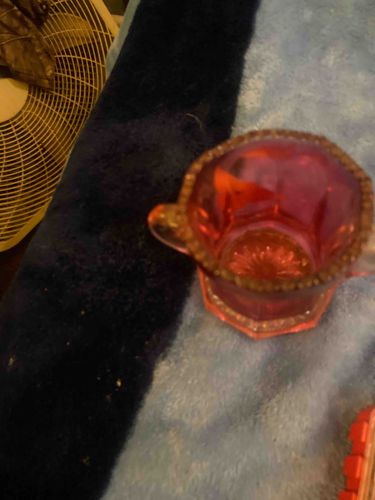
This item is a decorative sugar bowl crafted from what appears to be iridescent 'Carnival Glass.' The primary color of the glass is a rich, translucent ruby red, suggesting it could be 'Marigold' or a similar red variant of Carnival Glass. The item features a hexagonal base, which transitions into an octagonal body, indicating a molded construction that was common for this type of glass. The rim of the sugar bowl is adorned with a raised, stippled or beaded texture, which might be part of an overall pattern or a deliberate decorative edge. There are two small, C-shaped handles on opposite sides of the bowl, molded directly into the glass, consistent with the construction of a sugar bowl or creamer. The bottom interior of the bowl also shows a distinct sunburst or starburst pattern, further pointing to a molded design. The iridescence, characteristic of Carnival Glass, is visible, giving the surface a shimmering, multi-colored quality, especially around the edges and raised details. The item appears to be in good condition with no immediately visible chips, cracks, or significant wear, though the image quality makes it difficult to assess minor imperfections or manufacturing flaws. The style and construction suggest an estimated age from the early 20th century, likely between 1900 and 1930, when Carnival Glass was mass-produced and popular. No specific maker's marks are discernible from the provided image. The craftsmanship, while mass-produced, reflects the typical quality of antique decorative glass of that era.
AI Appraisal Report
Based on my visual examination of the provided image, this Carnival Glass sugar bowl in translucent ruby red exhibits characteristics typical of early 20th-century production (1900-1930). The hexagonal to octagonal body, molded C-shaped handles, stippled rim, and interior sunburst pattern are all consistent with common Carnival Glass manufacturing techniques and decorative motifs. The iridescence, a hallmark of Carnival Glass, appears well-preserved, suggesting good care. From the image, the condition appears good, with no visible chips, cracks, or significant wear, which is positive for value. Ruby red Carnival Glass, while attractive, is not as rare as some other colors or patterns. This particular piece appears to be a common sugar bowl form, likely from a well-known maker such as Northwood, Fenton, or Dugan, though without a discernible maker's mark, specific attribution is impossible.
Market conditions for common Carnival Glass forms are currently stable but not exceptionally strong for mass-produced items like this sugar bowl. Comparable pieces in good condition typically sell in the $60-$100 range. Demand for less common patterns or rare colors would fetch higher prices, but this piece falls more into the common decorative category. Its likely authenticity as genuine Carnival Glass is high given the visual cues, but without physical inspection, I cannot confirm the absence of minute flaws, internal stress fractures, or later repairs. An in-person examination would allow for definitive authentication of the glass type, a thorough condition assessment, and potentially the identification of a maker's mark often hidden on the base, which could slightly impact value within the given range. Provenance documentation, while helpful for unique pieces, is unlikely to be significant for an item of this type and value.