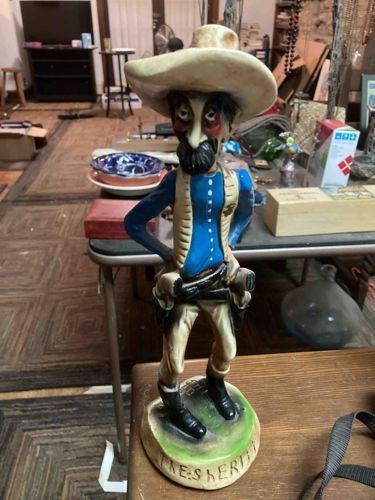
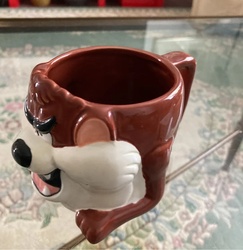
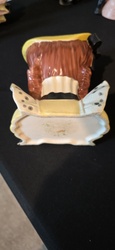
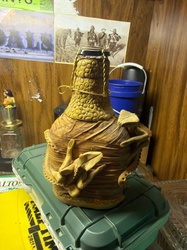
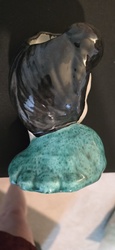
“the sheriff” 14 inch high ceramic statue by E Borman
These notes were written by the person who submitted this item. Appraiser.AI has not verified them, and the AI's identification and estimate may rely on them.
AI Estimated Value
Not an official valuation
$150 - $250
AI estimate as of November 12, 2025 · verify with a professional before acting
AI-Generated · Verify before acting
Everything on this page is generated by AI for informational purposes only. AI can make mistakes — the AI may misidentify items or misattribute them (artist, maker, brand, designer, origin, era). This is not an official valuation and should not be used for insurance, sale, tax, estate, legal, or lending purposes — or any decision requiring a certified appraisal. It is not an authoritative claim about any person, brand, or rights holder — do not share or rely on it as a factual statement about a third party. Always consult qualified professionals before making financial decisions.
This analysis also relies on unverified notes provided by the user, which may be incomplete or inaccurate and could affect the result.
This is a 14-inch high ceramic statue, clearly identified as 'The Sheriff' and attributed to the artist E. Borman. The statue depicts a character that appears to be a sheriff or lawman from the American Old West, characterized by a detailed, stylized design. The figure stands tall with a broad-brimmed, light-colored cowboy hat, likely off-white or beige, which significantly contributes to its overall silhouette. The face is elongated and caricatured, featuring prominent eyes with dark outlines and red-tinted areas around them, a large nose, and a solid black beard and mustache. The character wears a bright blue long-sleeved shirt with a row of small, light-colored buttons down the front, overlaid with a light-colored vest, possibly cream or tan, that includes vertical stitch-like details. His hands are positioned on his hips, with dark holsters visible on each side, holding dark-colored revolvers. The lower part of his attire consists of light-colored trousers, similar in shade to his vest, and black boots. The entire figure stands on an oval-shaped base, which is painted green on the top surface, simulating grass, and features the inscription 'THE SHERIFF' carved or embossed into the front in capital letters. The colors are applied in a somewhat flat but distinct manner, suggesting a handcrafted or studio pottery quality rather than mass industrial production. The visible condition appears good, with no obvious chips, cracks, or significant wear on the paint, indicating it has been well-preserved for its age. The style suggests it could be a collectible folk art piece or decorative item from the mid to late 20th century. The craftsmanship is evident in the sculptural details and the consistent color application, typical of a skilled artisan.
AI Appraisal Report
I have carefully examined the provided image of 'The Sheriff' 14-inch high ceramic statue by E. Borman. Visually, the condition appears to be excellent; I observe no obvious chips, cracks, or significant paint wear, which is crucial for ceramic collectibles. The inscription 'THE SHERIFF' on the base, along with the artist's attribution 'E. Borman,' strengthens its authenticity as a specific art piece, though verifying the artist's full identity and oeuvre would require further research. Given the stylized nature and apparent craftsmanship, it likely falls into the category of folk art or studio pottery from the mid to late 20th century.
Market conditions for such whimsical, character-driven ceramic statues by lesser-known artists can be varied. While there's a steady demand for unique decorative ceramic items, similar pieces generally appeal to niche collectors rather than a broad market. Comparable sales often hover in the low to mid-hundreds, depending on the artist's recognition and the piece's intricacy and condition. Rarity is difficult to ascertain from an image alone; if E. Borman produced a limited number of these, it could slightly boost value.
The primary factors impacting value here are its excellent condition and its distinctive, appealing aesthetic. To fully authenticate the artist and confirm the material quality, a physical examination would be essential. This would allow me to check for factory marks beyond the inscription, assess the glaze quality, confirm the ceramic type (e.g., earthenware, stoneware), and scrutinize for any hairline cracks or repairs not visible in photographs. Furthermore, provenance documentation, such as original sales receipts or exhibition history, would significantly enhance authenticity and value verification.