AI estimate as of July 19, 2025 · verify with a professional before acting
AI-Generated · Verify before acting
Everything on this page is generated by AI for informational purposes only. AI can make mistakes — the AI may misidentify items or misattribute them (artist, maker, brand, designer, origin, era). This is not an official valuation and should not be used for insurance, sale, tax, estate, legal, or lending purposes — or any decision requiring a certified appraisal. It is not an authoritative claim about any person, brand, or rights holder — do not share or rely on it as a factual statement about a third party. Always consult qualified professionals before making financial decisions.
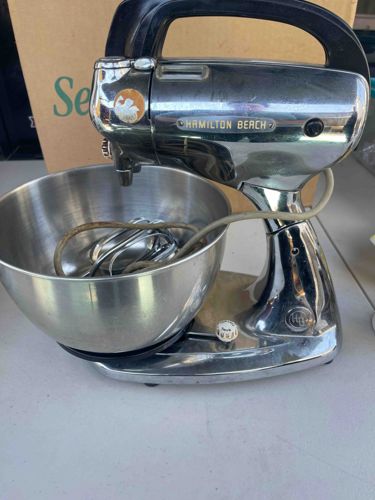
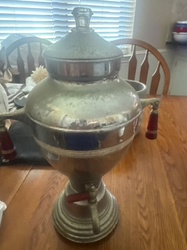
This is a vintage Hamilton Beach stand mixer, likely dating from the mid-20th century, possibly the 1950s or 1960s, given its design aesthetic. The mixer features a polished chrome or highly reflective metal body, exhibiting a classic, streamlined form. It has a distinctive black plastic handle integrated into the top of the motor unit, allowing it to be used as a portable hand mixer. The motor unit proudly bears the 'HAMILTON BEACH' brand name in raised or embossed lettering on a chrome plate, centered on its side. To the left of the brand name, there's a circular emblem with a visible logo, possibly a stylized bird or a 'HB' monogram, though it shows significant wear and discoloration. The mixer comes with a stainless steel mixing bowl, which appears to be in good, used condition, with some minor surface scratches consistent with use. Inside the bowl are two metal beaters for mixing attachments. The base of the mixer is also chrome, featuring a turntable mechanism for the bowl. A small, round, white control knob with 'H' and 'L' (presumably for High and Low speed settings) is visible on the base. The electrical cord, light in color, is original and shows some signs of age and possible stiffness. The chrome finish across the mixer body and base displays various degrees of surface wear, including scuffs, fingerprints, and some possible pitting or oxidation in areas, typical of an item of this age and material. Despite the wear, the overall construction appears sturdy, indicating good craftsmanship, and it likely retains its functional integrity.
AI Appraisal Report
Upon visual examination of the provided image, this vintage Hamilton Beach stand mixer appears to be an authentic model, likely from the 1950s or early 1960s. The 'HAMILTON BEACH' embossed lettering, classic streamlined chrome body, integrated handle for portable use, and distinctive control knob align with known models from that era. The presence of the original stainless steel bowl and two beaters adds to its completeness.
Its condition is fair to good for an item of this age. The chrome shows expected patination, including scuffs, fingerprints, and some possible pitting/oxidation, consistent with decades of use and storage. The worn circular emblem suggests genuine age. The electrical cord's visible stiffness is a concern for functionality and safety, requiring professional inspection or replacement. While appearing sturdy, full functional integrity cannot be confirmed without in-person testing.
Market conditions for vintage kitchen appliances like this typically see demand from collectors, nostalgia buyers, and those seeking functional vintage decor. Hamilton Beach mixers from this period are not exceptionally rare but are desirable. Comparables for working models in good cosmetic condition typically range from $75-$150. Non-working or poorer condition examples fetch less. Factors significantly impacting value here are the cosmetic wear, especially the chrome pitting, and the unconfirmed operational status due to the aged cord. If fully functional and electrically sound, its value would be higher.
Limitations in authenticity verification from the image alone are significant. While the design strongly suggests authenticity, without physical inspection, I cannot verify internal components, motor condition, or electrical safety. For full authentication and a more precise functional assessment, an in-person examination would be required, allowing for power testing, assessment of all moving parts, and a closer inspection of internal wiring and motor integrity. Provenance documentation (e.g., original sales receipts) would further enhance authentication, though rarely available for such items.