These notes were written by the person who submitted this item. Appraiser.AI has not verified them, and the AI's identification and estimate may rely on them.
AI Estimated Value
Not an official valuation
$25-45
AI estimate as of December 3, 2025 · verify with a professional before acting
AI-Generated · Verify before acting
Everything on this page is generated by AI for informational purposes only. AI can make mistakes — the AI may misidentify items or misattribute them (artist, maker, brand, designer, origin, era). This is not an official valuation and should not be used for insurance, sale, tax, estate, legal, or lending purposes — or any decision requiring a certified appraisal. It is not an authoritative claim about any person, brand, or rights holder — do not share or rely on it as a factual statement about a third party. Always consult qualified professionals before making financial decisions.
This analysis also relies on unverified notes provided by the user, which may be incomplete or inaccurate and could affect the result.
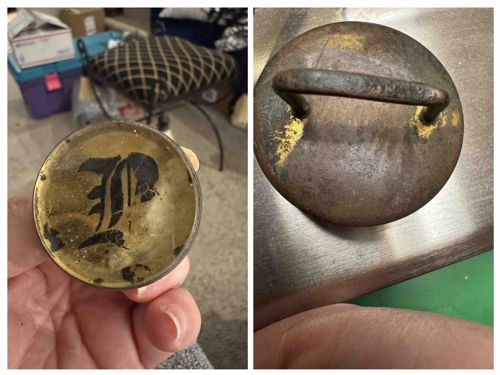
This is an antique equestrian bridle rosette, likely dating from the late 19th to early 20th century. The item is circular in shape, approximately 2 to 3 inches in diameter based on its appearance in a human hand, and appears to be constructed from brass or a brass alloy, possibly with a glass or celluloid cover over the decorative front. The front features a highly stylized, dark-colored letter 'P' monogram set against a gold-toned background. The monogram shows significant wear, with portions of the dark design flaked off, revealing the lighter background beneath. The gold background itself exhibits considerable tarnishing and discoloration, presenting a mottled appearance with areas of brighter gold contrasting with darker, oxidized regions. The edges of the front face show some chipping or loss of the overlaying material, exposing the metallic base. The reverse side of the rosette, visible in the second image, is convex and made of a darker, heavily patinated metal, consistent with aged brass or bronze. It features a sturdy, U-shaped loop or staple, firmly attached to the center, which would have been used to secure the rosette to the horse's bridle. The metal on the back is significantly corroded and discolored, with patches of what appears to be green or yellow verdigris, indicating long-term exposure and oxidation characteristic of an item used outdoors. The overall condition suggests heavy use and age, with a well-developed patina and visible signs of material degradation. The craftsmanship, while functional, appears utilitarian rather than highly ornate, typical for its purpose.
AI Appraisal Report
Upon examining the provided images of this antique equestrian bridle rosette, my assessment concludes it is a genuine artifact from the late 19th or early 20th century. The materials, including the brass base, the patination, and the style of the 'P' monogram under what appears to be a glass or celluloid cover, are consistent with pieces from this era. The condition is fair to poor, showing significant wear commensurate with its age and utilitarian function. The flaking of the monogram, tarnishing of the gold-toned background, chipping on the edges, and heavy verdigris on the reverse side are all indicators of extensive use and long-term exposure to the elements. These condition issues, while attesting to its age, significantly detract from its market value.
The market for common monogrammed bridle rosettes is relatively modest. While equestrian collectibles have a dedicated following, items without specific provenance, maker's marks, or association with a famous stable or rider tend to trade at lower values. Similar individual rosettes in this condition frequently sell in the $25 to $45 range at auction and online marketplaces. The monogram 'P' does not, in itself, add significant value without a known history. Stronger prices are typically reserved for pairs, sets, or those with more intricate or desirable designs, such as figural motifs, in better condition.
It is important to note that this appraisal is based solely on digital images. A definitive authentication would require in-person examination to confirm the materials (e.g., testing the metal content, identifying the cover material as glass or early plastic) and to search for any faint maker's marks not visible in the photographs. Without physical inspection or provenance documentation, the possibility of it being a later reproduction, though unlikely given the authentic-appearing wear, cannot be entirely dismissed.