AI estimate as of October 27, 2025 · verify with a professional before acting
AI-Generated · Verify before acting
Everything on this page is generated by AI for informational purposes only. AI can make mistakes — the AI may misidentify items or misattribute them (artist, maker, brand, designer, origin, era). This is not an official valuation and should not be used for insurance, sale, tax, estate, legal, or lending purposes — or any decision requiring a certified appraisal. It is not an authoritative claim about any person, brand, or rights holder — do not share or rely on it as a factual statement about a third party. Always consult qualified professionals before making financial decisions.
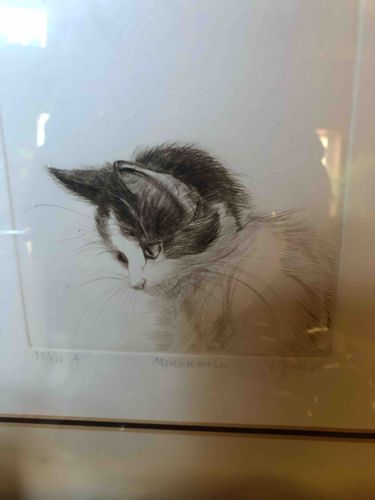
This item is a framed, limited edition etching featuring a detailed portrait of a young cat or kitten. The artwork is rendered in monochromatic tones, likely black ink on white paper, highlighting the delicate fur texture and expressiveness of the animal. The cat is depicted in profile, looking downwards and to the left, with prominent whiskers and finely detailed fur, particularly around its ears and head. The style appears to be a drypoint etching or similar intaglio printmaking technique, characterized by fine lines and a soft, slightly fuzzy quality, especially noticeable in the darker areas of the fur.
Visible markings below the image include '37/100 A', indicating that this is the 37th print out of an edition of 100, and potentially an artist's proof or special designation 'A'. To the right, obscured text appears to read 'Meisterschwänzchen', which translates from German to 'master's tail' or 'little master's tail', likely the title of the piece. Further to the right, what looks like a signature and possibly a date are present but largely illegible due to blurriness and glare. The print is housed under glass within a simple, light-colored frame, possibly wood or metal, which has a matte or frosted appearance. The overall presentation suggests a professional framing job. The print itself appears to be in good condition, with no immediate visible signs of foxing, discoloration, or tears. The frame shows some slight reflections due to lighting conditions, but no apparent damage or wear.
AI Appraisal Report
I have examined the provided image of the framed limited edition etching 'Meisterschwänzchen'. The print depicts a charming, detailed portrait of a young cat in monochromatic tones, executed with what appears to be a drypoint etching technique, indicated by the fine lines and soft tonal quality. The visible edition number '37/100 A' confirms its status as a limited edition print. The aesthetic appeal of animal portraits, particularly cats, generally holds a steady market. The 'A' designation could indicate an artist's proof (AP), which sometimes commands a premium, or another specific variant within the edition.
Condition appears good; the print shows no immediate signs of foxing, discoloration, or physical damage. The framing is professional and appropriate for the piece. However, the illegibility of the signature and potential date is a significant limitation. While 'Meisterschwänzchen' is a lovely title, without a verifiable artist's signature, attribution cannot be confirmed from the image alone. This significantly impacts market value, as an unsigned or unattributed fine art print will typically fetch less than a fully authenticated work by a recognized artist.
Comparables for limited edition animal etchings by lesser-known or unattributed artists can range from $100 to $400, depending on quality and aesthetic appeal. If this were a known artist, the value could be considerably higher. Demand for cat-themed art is generally consistent, benefiting this piece. Rarity is moderate, given the edition size of 100. For full authentication and to potentially unlock higher value, an in-person examination is critical to assess the signature, paper quality, and printing method. Provenance documentation (e.g., certificate of authenticity, sales records) would be paramount to confirm the artist and full history. Scientific testing, such as microscopic analysis of the printmaking process, could also aid, but usually only for high-value works.