AI estimate as of December 16, 2025 · verify with a professional before acting
AI-Generated · Verify before acting
Everything on this page is generated by AI for informational purposes only. AI can make mistakes — the AI may misidentify items or misattribute them (artist, maker, brand, designer, origin, era). This is not an official valuation and should not be used for insurance, sale, tax, estate, legal, or lending purposes — or any decision requiring a certified appraisal. It is not an authoritative claim about any person, brand, or rights holder — do not share or rely on it as a factual statement about a third party. Always consult qualified professionals before making financial decisions.
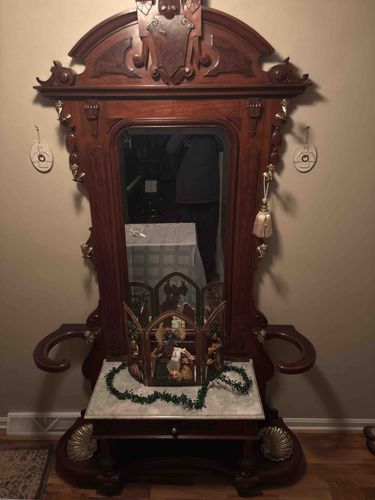
This is a full-length Victorian hall stand, likely crafted from solid walnut, characterized by its rich, dark brown finish and substantial construction. The piece features an upright design with a tall, rectangular mirror at its center, framed by an elaborately carved wooden structure. The top section showcases classical ornamentation, including a central carved shield or cartouche flanked by volutes and smaller decorative elements, all indicative of the Aesthetic Movement or Eastlake style prevalent in the late 19th century. Below the mirror, there is a flat marble top surface, light in color with visible veining, suggesting either Carrara or similar white marble. This marble surface serves as a console or display area. Beneath the marble top, a single small drawer with a brass pull provides discreet storage. The lower section consists of a sturdy base, incorporating curved supports and possibly small shelves or stands, and is adorned with decorative shell-like appliqués on the side supports. The overall construction exhibits quality craftsmanship, with visible mortise and tenon joinery where elements meet, and detailed carving that adds depth and character. The wood appears to be in good condition, showing a natural patina consistent with age. There are no immediately obvious signs of major damage or repairs, although minor wear to the finish or some discoloration on the marble would be typical for an item of this age. The style suggests an estimated age from the late 19th century, likely between 1870 and 1900. Unique features include the prominent marble top and the intricate, symmetrical carving, which would have been handmade. The heavy, robust nature of the piece indicates it was designed for a formal entryway.
AI Appraisal Report
Based on my visual examination of the provided image, this Victorian Walnut Hall Stand with Marble Top presents as a substantial and well-crafted piece. The dark, rich finish and robust construction are consistent with solid walnut, though a physical inspection would be required to confirm the wood species and detect any veneers. The overall condition appears to be good, with a natural patina a testament to its age. I noted no obvious major damage or repairs, which is a significant plus for value; however, minor wear to the finish and discoloration or slight pitting on the marble, typical for an item from the late 19th century (circa 1870-1900), would need to be assessed in person. The design, with its elaborate carving, central shield motif, and volutes, strongly suggests the Aesthetic Movement or Eastlake style, enhancing its authenticity for the period. The prominent marble top and intricate, symmetrical carving are particularly desirable features, indicating higher quality craftsmanship likely executed by hand. In today's market, large, well-preserved Victorian hall stands of this caliber, especially with marble tops and decorative carving, generally see steady demand. Comparable sales for similar quality pieces range from $1,000 to $2,500, depending heavily on condition, designer attribution if any, and regional buyer interest. This piece's size and formal nature mean it appeals to a specific collector base, but its excellent presentation points to the higher end of its market segment. The rarity of such a complete and seemingly undamaged piece also positively impacts its value. A full authentication would necessitate in-person examination to verify wood, construction methods (confirming mortise and tenon joinery), assess internal drawer construction, and thoroughly inspect the marble for repairs or significant damage. Provenance documentation, if available, could further augment value by confirming its history or original ownership.