These notes were written by the person who submitted this item. Appraiser.AI has not verified them, and the AI's identification and estimate may rely on them.
AI Estimated Value
Not an official valuation
$150-250
AI estimate as of July 24, 2025 · verify with a professional before acting
AI-Generated · Verify before acting
Everything on this page is generated by AI for informational purposes only. AI can make mistakes — the AI may misidentify items or misattribute them (artist, maker, brand, designer, origin, era). This is not an official valuation and should not be used for insurance, sale, tax, estate, legal, or lending purposes — or any decision requiring a certified appraisal. It is not an authoritative claim about any person, brand, or rights holder — do not share or rely on it as a factual statement about a third party. Always consult qualified professionals before making financial decisions.
This analysis also relies on unverified notes provided by the user, which may be incomplete or inaccurate and could affect the result.
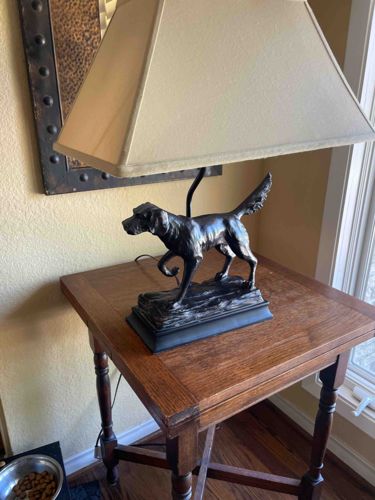
This is a tabletop electric lamp featuring a sculptural base depicting a hunting dog. The dog figure, likely a setter or a pointer, is rendered in a dark, possibly bronze or iron-like finish, suggesting it could be cast metal (e.g., spelter, cast iron, or resin with a metallic coating). The dog is sculpted in a pointed or retrieving stance, with its tail raised and one front paw slightly lifted, standing on a textured base that appears to mimic natural terrain, possibly logs or uneven ground. This sculptural element is mounted onto a rectangular, darker, possibly black or dark brown, plinth-style base with a slightly broader perimeter, providing stability for the lamp. The lamp's arm, emerging from behind the dog figure, is a slender, curved standard in a matching dark finish, supporting a standard lamp socket assembly. The lampshade is a classic rectangular or tapered rectangular shape made of a light-colored fabric, likely linen or a similar natural fiber, in a beige or cream hue. The fabric has a visible texture, and the edges of the shade appear to be reinforced or trimmed. The overall aesthetic suggests an early to mid-20th-century design influence, possibly leaning towards a more rustic or lodge-style decor, or even a 'gentleman's study' type of ambiance. The finish on the dog sculpture appears relatively intact with some potential highlights from light reflections, but without closer inspection, it's hard to ascertain the exact material or detail of any wear or patina. The electrical cord is visible, indicating a standard plug-in operation. There are no readily visible manufacturer's marks or signatures from the provided images. The piece exhibits a generally good presentation, suitable for functional lighting with a decorative, thematic appeal.
AI Appraisal Report
Upon my examination of the provided images for this Hunting Dog Table Lamp, I find it to be a charming and well-preserved decorative lighting piece. The sculptural base, depicting a hunting dog in a characteristic pose, immediately catches the eye. While the exact material of the dog figure (be it spelter, cast iron, or resin with a metallic coating) cannot be definitively determined from images alone, its dark, possibly bronze-like finish suggests a robust construction. The overall condition appears good, with no discernible major damage to the sculpture or the base plinth. The accompanying light-colored fabric shade complements the rustic theme.
In terms of market conditions, vintage figural lamps, particularly those with a sporting or outdoor theme, consistently find buyers. While not exceedingly rare, a well-executed piece like this has a niche appeal. Its design aesthetics point towards an early to mid-20th-century origin, placing it in the popular 'vintage' category. Demand for such thematic items is steady among collectors and individuals furnishing lodge-style homes or studies.
Factors significantly impacting its value include its overall visual appeal, apparent good condition, and functional state. The material of the dog sculpture would be a key determinant during an in-person assessment; a cast metal piece would command more than a resin alternative.
It is crucial to note that without a physical examination, I cannot attest to the authenticity of the material (e.g., distinguishing between cast metal and high-quality resin), nor can I check for manufacturer's marks, internal wiring integrity, or subtle imperfections not visible in photographs. An in-person inspection would allow me to assess the exact material, check for any repairs, and examine the electrical components for safety and originality. Provenance documentation, if available, detailing its history and origin, would further enhance its value and confirm authenticity.