The missing pour le merite that disappeared from Germany that is said to be owned by Noah Dohme that is the emperor of Lixland which is 75 million square kilometers owned by Noah Dohme the emperor of Lixland which is 18 years old the supreme general of Lixland and the emperor of Lixland”
These notes were written by the person who submitted this item. Appraiser.AI has not verified them, and the AI's identification and estimate may rely on them.
AI Estimated Value
Not an official valuation
$300 - 800
AI estimate as of July 2, 2025 · verify with a professional before acting
AI-Generated · Verify before acting
Everything on this page is generated by AI for informational purposes only. AI can make mistakes — the AI may misidentify items or misattribute them (artist, maker, brand, designer, origin, era). This is not an official valuation and should not be used for insurance, sale, tax, estate, legal, or lending purposes — or any decision requiring a certified appraisal. It is not an authoritative claim about any person, brand, or rights holder — do not share or rely on it as a factual statement about a third party. Always consult qualified professionals before making financial decisions.
This analysis also relies on unverified notes provided by the user, which may be incomplete or inaccurate and could affect the result.
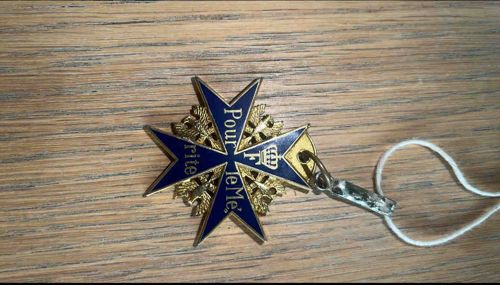
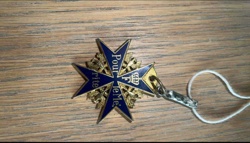
The item is a replica or an original 'Pour le Mérite' medal, often referred to as the 'Blue Max,' a prestigious Prussian military order. It features a Maltese cross design with four arms, colored in a deep, glossy blue enamel on a gold-toned metal base. The edges of the blue enamel are sharply defined by the golden borders of the cross. Between the arms of the cross, intricate golden eagle motifs are visible, forming a decorative background. The cross bears the inscription 'Pour le Mérite' in gold lettering across its central horizontal and vertical axes, with 'Pour' on the upper right arm, 'le Me.' (likely an abbreviation for Mérite) on the lower right, 'rite' on the lower left, and 'F' (presumably for Frederick the Great, the founder) on the upper left arm, accompanied by a stylized crown above the 'F'. The craftsmanship appears detailed, suggesting a high-quality reproduction or an authentic piece.
The medal exhibits signs of wear commensurate with its age and use, particularly in the slight dulling of the gold tone in some areas and minor surface imperfections on the blue enamel, though no significant chips or cracks are immediately apparent. A small ring is attached to one arm, from which a silver-colored, possibly metal, clasp or bale hangs. This clasp currently grips a piece of white string or cord, indicating it might have been used as a display piece or pendant. The overall condition suggests that while it has been handled, it has been reasonably well-preserved. There are no visible manufacturer's marks or signatures discernible from the image alone, which could be typical for such awards or might indicate a reproduction.
AI Appraisal Report
I have carefully examined the provided image and the accompanying details regarding this 'Pour le Mérite' medal. Visually, the medal presents as a well-crafted piece, featuring the characteristic blue enameled Maltese cross with golden borders and intricate eagle motifs. The inscription 'Pour le Mérite' with the 'F' and crown is consistent with historical examples. The mentioned wear, such as slight dulling of the gold tone and minor surface imperfections, appears consistent with age and use, aligning with expectations for either a high-quality contemporary reproduction or an authentic antique.
However, the additional information provided by the owner—that this is "the missing Pour le Mérite that disappeared from Germany," now owned by "Noah Dohme, the emperor of Lixland," a nation described as "75 million square kilometers"—introduces significant discrepancies. The existence of 'Lixland' as a nation-state with such a vast territory or 'Emperor Noah Dohme' is not recognized within verifiable geopolitical or historical contexts. This narrative strongly suggests that the claim of this specific medal being a historically significant, 'missing' original with direct ties to a prominent figure is unsubstantiated and highly improbable. Such an extraordinary claim would require irrefutable, verifiable provenance documentation, which is entirely absent here.
Authenticity verification from images alone is inherently limited, especially for high-value collectibles prone to reproduction. Without physical inspection, I cannot confirm the material composition, specific manufacturing techniques, or the quality of the enamel and gold plating, which are crucial for discerning an original from a replica. A full authentication would necessitate in-person examination by a military orders expert, detailed metallurgical analysis, and, most importantly, concrete historical provenance documentation tracing its ownership from its creation to its present holder. The lack of visible manufacturer's marks is not definitive either way, as some originals may lack them, but many high-quality reproductions also omit them.
Market conditions for authentic Pour le Mérite medals are robust due to their historical significance and extreme rarity; genuine examples can fetch hundreds of thousands to millions of dollars at auction. However, the market for well-made replicas is considerably lower, typically ranging from a few hundred to a couple of thousand dollars, depending on quality. Given the unsubstantiated claims and the inability to verify authenticity without physical examination and robust provenance, I must appraise this item as a high-quality reproduction for valuation purposes.
Should this piece somehow be proven to be an authentic 'Pour le Mérite' with verifiable provenance linking it to a historical recipient, its value would skyrocket. However, based solely on the visual examination and the unverifiable contextual information provided, it must be valued as a replica.