These notes were written by the person who submitted this item. Appraiser.AI has not verified them, and the AI's identification and estimate may rely on them.
AI Estimated Value
Not an official valuation
$50-100
AI estimate as of September 10, 2025 · verify with a professional before acting
AI-Generated · Verify before acting
Everything on this page is generated by AI for informational purposes only. AI can make mistakes — the AI may misidentify items or misattribute them (artist, maker, brand, designer, origin, era). This is not an official valuation and should not be used for insurance, sale, tax, estate, legal, or lending purposes — or any decision requiring a certified appraisal. It is not an authoritative claim about any person, brand, or rights holder — do not share or rely on it as a factual statement about a third party. Always consult qualified professionals before making financial decisions.
This analysis also relies on unverified notes provided by the user, which may be incomplete or inaccurate and could affect the result.
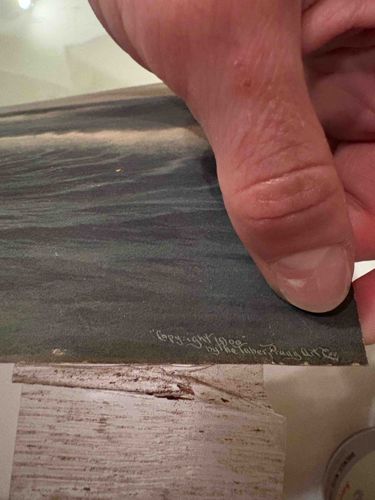
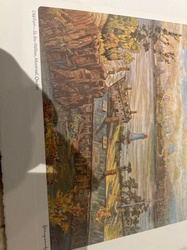
The item is a portion of a vintage print, likely an art print or decorative illustration, characterized by its muted color palette, predominantly featuring dark blues, grays, and hints of lighter tones suggesting a sky or distant horizon over a body of water. The visible section of the print itself is rectangular, made of a paper-like material, and appears to be mounted or previously attached to a thicker substrate, possibly cardboard or wood, which is now damaged. The most distinguishing feature is the printed text in the bottom left corner, which reads: "'Copyright 1900' by the Taber-Prang Art Co." This clearly indicates its manufacturing origin and a precise date. The lettering is in a delicate, almost script-like font, slightly stylized, and appears in a light, possibly white or very pale gray, against the darker background of the print. The visible edge of the print exhibits some wear, with a rough, uneven quality, suggesting it may have been torn or cut from a larger piece, or experienced handling damage over time. The mounting material beneath it is significantly damaged and flaky, showing exposed wood-like fibers that are light in color, appearing aged and brittle. The overall condition suggests advanced age and some deterioration, adding to its vintage character. The precise image depicted within the print is mostly obscured by a hand holding it, but the general impression is that of a landscape or seascape. The craftsmanship of the original print, based on the legible text, would have been industrial, typical of fine art reproduction companies of the early 20th century. The quality of the reproduction implies a deliberate artistic intention, likely an attempt to replicate a painting or drawing.
AI Appraisal Report
Based on my examination of the provided image, this vintage print, clearly marked "Copyright 1900 by the Taber-Prang Art Co.," possesses inherent historical value as a product of a prominent early 20th-century art reproduction firm. The visible portion of the print, with its muted tones and landscape/seascape suggestion, aligns with the aesthetic of the period. Authenticity is strongly supported by the legible copyright text; I find no immediate red flags to suggest it is not a genuine Taber-Prang print from 1900.
However, the overall condition significantly impacts its market value. The print itself shows wear, and the mounting material is severely damaged and flaky, indicating advanced deterioration. The tearing or rough cutting of the print also detracts from its display potential. Without seeing the full image, it's impossible to assess its artistic merit or subject desirability, which are major factors in collectible art. Taber-Prang prints, while historically interesting, generally do not command high prices unless they are rare subjects, in excellent condition, or by a particularly sought-after artist (which is unlikely for mass-produced prints of this nature).
The market for antique prints is selective, favoring strong condition and compelling imagery. This item, in its current state, would appeal primarily to collectors of ephemera or those interested in early 20th-century printing history, rather than fine art collectors. Demand is moderate for such pieces, with rarity being tied more to condition than the print itself. Factors reducing value include the extensive damage and the obscured image.
Limitations: My assessment is based solely on the provided image. For full authentication and a more precise valuation, a physical inspection would be crucial to assess the paper quality, printing technique details, and the full extent of the damage. Provenance documentation, though rare for such items, could add value. Scientific testing is generally not cost-effective or necessary for prints of this perceived value.