AI estimate as of October 12, 2025 · verify with a professional before acting
AI-Generated · Verify before acting
Everything on this page is generated by AI for informational purposes only. AI can make mistakes — the AI may misidentify items or misattribute them (artist, maker, brand, designer, origin, era). This is not an official valuation and should not be used for insurance, sale, tax, estate, legal, or lending purposes — or any decision requiring a certified appraisal. It is not an authoritative claim about any person, brand, or rights holder — do not share or rely on it as a factual statement about a third party. Always consult qualified professionals before making financial decisions.
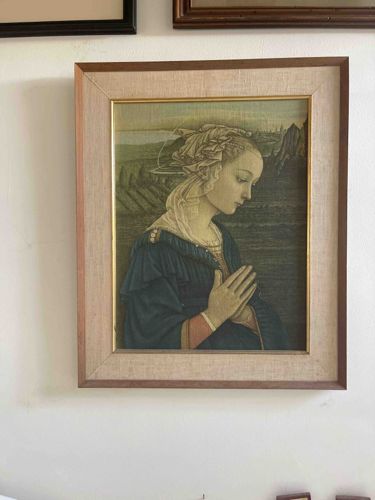
This item is a framed print depicting a detail from Sandro Botticelli's renowned Renaissance painting 'Madonna of the Magnificat', specifically focusing on the figure of a praying angel or saint. The print measures approximately 16-18 inches in height and 12-14 inches in width (estimated, based on visible proportions and typical print sizes). The colors are rich and vibrant, showcasing a palette dominated by deep blues, muted greens, and warm skin tones, characteristic of Botticelli's work. The figure is shown in profile, with hands clasped in prayer, adorned with a flowing head covering and delicate facial features. The background features a detailed landscape with rolling hills and architectural elements. The print itself appears to be a high-quality reproduction, likely an offset lithograph or giclée print, given the clarity of detail and color fidelity. It is housed within a two-part frame construction: an inner frame that appears to be a narrow gold-toned or brass-toned metal fillet, directly bordering the print, followed by a wider outer frame made of a light-colored wood, possibly oak or maple, with a visible grain. Between the inner and outer frames, there is a fabric-covered mat, likely linen or a similar material, in a neutral, light beige or off-white color, which adds depth and visual separation. The frame shows minor signs of wear consistent with age, such as potential scuff marks on the wood or slight discoloration on the fabric mat, though these are not clearly discernible in the provided images. No specific artist's signature, reproduction details, or frame maker's marks are visible. The style period is clearly Renaissance, relating to the original artwork, but the print and framing style suggest a mid-to-late 20th-century or early 21st-century production for decorative purposes. The craftsmanship of the framing appears to be standard; however, the impact of the original artwork's classic aesthetic is well-preserved in this reproduction.
AI Appraisal Report
I have examined the provided image of the framed print depicting a detail from Botticelli's 'Madonna of the Magnificat'. Based on my visual assessment, the print appears to be a high-quality reproduction, likely an offset lithograph or giclée, given its clarity and vibrant color fidelity. The framing consists of an inner gold-toned fillet, a neutral fabric mat, and a wider light-colored wooden outer frame. The condition appears good, with minor wear typical of a decorative item of its age, which I estimate to be mid-to-late 20th century or early 21st century. The craftsmanship of the framing seems standard, fitting for a decorative reproduction.
Market conditions for such reproductions are generally stable but do not command high values. Comparables for similar framed Botticelli prints of this size typically fall within the $50-$150 range on secondary markets and online platforms. Demand exists for decorative art, especially classic religious or Renaissance themes, but these prints are not rare, as mass-produced reproductions are widely available. The primary value drivers here are the aesthetic appeal of a classic artwork and the quality of the reproduction and framing as a decorative piece for the home.
Authenticity, in terms of being an original Botticelli, is not applicable as this is clearly a print. However, without physical inspection, I cannot confirm the print medium (e.g., lithograph, giclée), paper quality, or the exact materials and construction of the frame. An in-person examination would allow for precise measurements, closer inspection for any hidden inscriptions or artist proofs, and a detailed assessment of the frame's material and condition. Provenance documentation would typically not apply to a decorative print of this nature. However, a physical inspection could determine if it is a limited edition print, which could slightly increase its value, though this is unlikely for such a common image.