AI estimate as of June 25, 2025 · verify with a professional before acting
AI-Generated · Verify before acting
Everything on this page is generated by AI for informational purposes only. AI can make mistakes — the AI may misidentify items or misattribute them (artist, maker, brand, designer, origin, era). This is not an official valuation and should not be used for insurance, sale, tax, estate, legal, or lending purposes — or any decision requiring a certified appraisal. It is not an authoritative claim about any person, brand, or rights holder — do not share or rely on it as a factual statement about a third party. Always consult qualified professionals before making financial decisions.
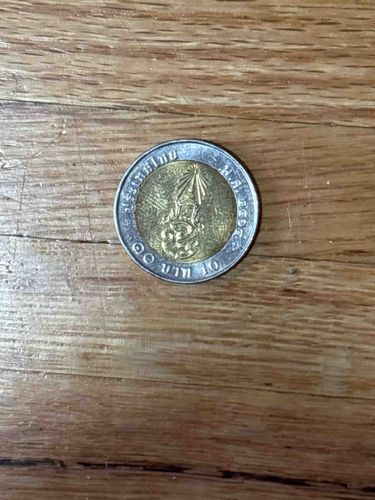
The item is a bimetallic coin, specifically a Thai 10 Baht coin. It features a silver-colored outer ring and a brass-colored inner core. The overall diameter appears to be standard for this denomination, likely around 26 mm. The obverse side, visible in the image, displays a central effigy, which upon closer inspection, represents King Bhumibol Adulyadej (Rama IX) of Thailand, a common motif on Thai currency during his reign. Surrounding the central image are Thai characters and numerals, indicating the denomination "10 Baht" and likely the issuing country or a date. The coin shows signs of circulation, including some light scratches and dulling of the metallic luster, particularly on the brass core, which has lost some of its original shine. There are no significant dents, deep scratches, or corrosive damage visible, suggesting a good circulated condition rather than pristine, uncirculated quality. The craftsmanship is typical of modern government-issued coinage, with clear and precise engraving, though the finer details are slightly softened by wear. This coin likely dates from the late 20th to early 21st century, falling within King Bhumibol's long reign (1946-2016). There are no evident manufacturing defects, maker's marks beyond the standard national minting, or unique alterations. The edges are not visible, but typically these coins have reeded edges. The quality is consistent with mass-produced currency, designed for durability in everyday transactions.
AI Appraisal Report
I have examined the image of this Thai 10 Baht bimetallic coin. Based on visual assessment, the coin appears authentic, consistent with standard issues from King Bhumibol Adulyadej
DCM-s reign (1946-2016). The effigy, bimetallic composition (silver-colored outer ring, brass-colored inner core), and visible Thai script align with known examples of this denomination.The coin exhibits signs of circulation, including light scratches and dulled luster on the brass core. I would classify its condition as Good Circulated (GC) to Very Good (VG), indicating normal wear from everyday use but no significant damage like deep scratches, dents, or corrosion. This condition is typical for mass-produced currency.In terms of market conditions, Thai 10 Baht coins, especially those in circulated condition, are widely available and do not command a significant premium beyond their face value in most numismatic markets. Demand for common circulated issues is generally moderate, driven more by new collectors or those seeking a complete set of everyday circulation coinage rather than high-end investors. Rarity is not a factor for this type of coin; millions were minted.Factors significantly impacting value upwards would include uncirculated condition, rare mint errors, or specific commemorative issues, none of which appear to be present here. Conversely, severe damage or counterfeiting would drastically reduce value.For full authentication, especially for higher value coins, an in-person examination is crucial. This would allow for tactile inspection of the planchet, edge reeding, and weight verification, which cannot be determined from an image. A detailed examination under magnification would reveal finer details of wear and potential alterations. While this coin appears legitimate from the image, provenance documentation (e.g., from a reputable dealer) or scientific testing (e.g., metal composition analysis) would provide definitive proof of authenticity, particularly if there were any doubts. However, given its common nature, such extensive testing is generally not economically warranted.